Command Palette
Search for a command to run...
RefineAnything : Raffinement multimodal spécifique à la région pour des détails locaux parfaits
RefineAnything : Raffinement multimodal spécifique à la région pour des détails locaux parfaits
Dewei Zhou You Li Zongxin Yang Yi Yang
Résumé
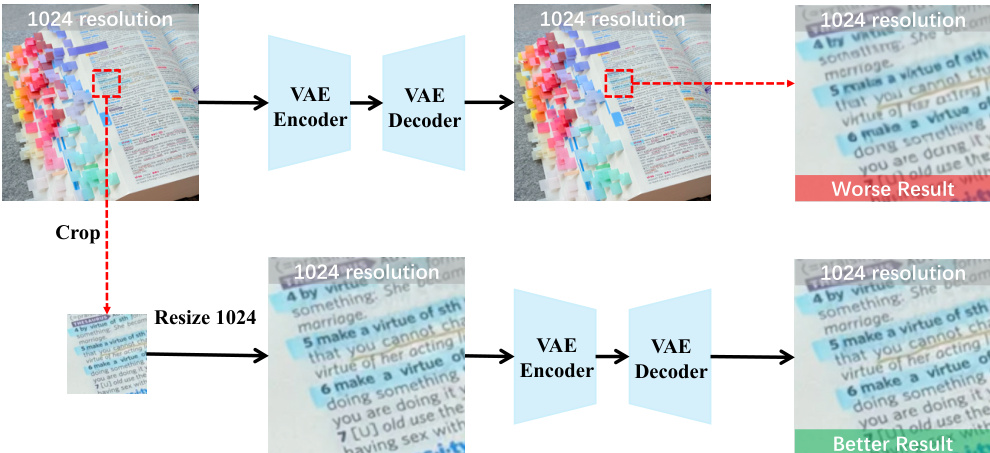
Voici la traduction de votre texte en français, respectant les standards de rigueur scientifique et technique demandés :Nous introduisons le raffinement d'image par région spécifique (region-specific image refinement) en tant que problématique dédiée : étant donné une image d'entrée et une région spécifiée par l'utilisateur (par exemple, un masque de type scribble ou une boîte de délimitation/bounding box), l'objectif est de restaurer des détails fins tout en maintenant tous les pixels non édités strictement inchangés. Malgré les progrès rapides de la génération d'images, les modèles modernes souffrent encore fréquemment d'un effondrement des détails locaux (local detail collapse), tel que la distorsion de textes, de logos ou de structures fines. Les modèles d'édition actuels pilotés par instructions mettent l'accent sur des modifications sémantiques grossières et négligent souvent les défauts locaux subtils ou modifient par inadvertance l'arrière-plan, en particulier lorsque la région d'intérêt n'occupe qu'une petite partie d'une entrée à résolution fixe.Nous présentons RefineAnything, un modèle de raffinement multimodal basé sur la Diffusion qui prend en charge le raffinement avec référence (reference-based) et sans référence (reference-free). En nous appuyant sur une observation contre-intuitive selon laquelle le processus de découpage et de redimensionnement (crop-and-resize) peut améliorer considérablement la reconstruction locale sous une résolution d'entrée VAE fixe, nous proposons Focus-and-Refine. Il s'agit d'une stratégie de raffinement centrée sur la région suivie d'un recollement (refinement-and-paste-back), qui améliore l'efficacité et la performance du raffinement en réallouant le budget de résolution à la région cible, tandis qu'un recollement par masque fondu (blended-mask paste-back) garantit une préservation stricte de l'arrière-plan. Nous introduisons en outre une perte de cohérence de bordure sensible aux limites (boundary-aware Boundary Consistency Loss) afin de réduire les artefacts de couture (seam artifacts) et d'améliorer le naturel du recollement.Pour soutenir ce nouveau cadre, nous construisons Refine-30K (comprenant 20 000 échantillons avec référence et 10 000 échantillons sans référence) et introduisons RefineEval, un benchmark qui évalue à la fois la fidélité de la région éditée et la cohérence de l'arrière-plan. Sur RefineEval, RefineAnything obtient des améliorations significatives par rapport aux modèles de référence (baselines) concurrents et assure une préservation quasi parfaite de l'arrière-plan, établissant ainsi une solution pratique pour le raffinement local de haute précision.Page du projet : https://limuloo.github.io/RefineAnything/.
One-sentence Summary
The authors propose RefineAnything, a multimodal diffusion-based model for high-precision, region-specific image refinement that utilizes a Focus-and-Refine strategy and a Boundary Consistency Loss to restore local details while ensuring strict background preservation, outperforming competitive baselines on the newly introduced RefineEval benchmark.
Key Contributions
- The paper presents RefineAnything, a multimodal diffusion-based refinement model designed for both reference-based and reference-free tasks to restore fine-grained local details.
- The authors introduce the Focus-and-Refine strategy, which reallocates resolution to a target region through a crop-and-resize approach and uses a blended-mask paste-back method to ensure strict background preservation.
- This work contributes a boundary-aware Boundary Consistency Loss to minimize seam artifacts and provides Refine-30K and RefineEval, a new benchmark for evaluating edited-region fidelity and background consistency.
Introduction
While modern diffusion models have achieved significant progress in high-fidelity image generation, they frequently suffer from local detail collapse, resulting in distorted text, logos, and thin structures. Existing instruction-driven editing models typically focus on coarse-grained semantic changes and often fail to address subtle local defects or inadvertently alter the background when editing small regions. To address these issues, the authors introduce RefineAnything, a multimodal diffusion-based framework designed for region-specific refinement. The authors leverage a Focus-and-Refine strategy that concentrates model capacity on user-specified areas to restore fine-grained details while ensuring strict background preservation through a specialized boundary-aware loss.
Dataset
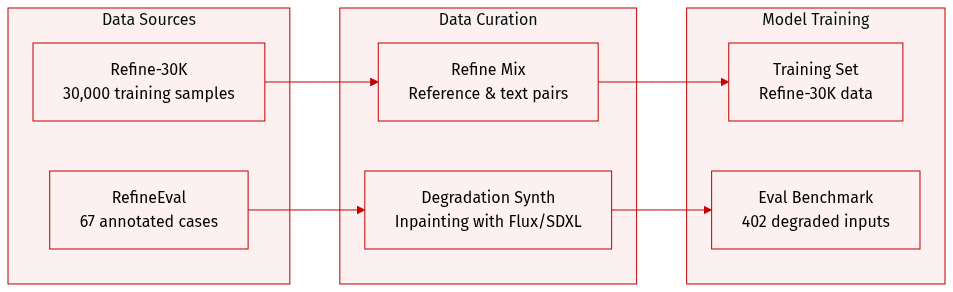
The authors introduce two distinct datasets to support the training and evaluation of the RefineAnything model:
-
Refine-30K (Training Dataset): This dataset contains 30,000 samples divided into two specific subsets:
- Reference-based refine pairs (20,000 samples): These samples provide the model with both a refinement instruction and a reference image to guide the visual style and appearance.
- Reference-free refine samples (10,000 samples): These instruction-only samples require the model to perform refinements based solely on text specifications.
-
RefineEval (Evaluation Benchmark): A curated benchmark consisting of 402 degraded inputs derived from 67 manually annotated cases. The benchmark is structured as follows:
- Composition: It includes 31 reference-based cases focusing on identity-sensitive content like logos and person IDs, and 36 reference-free cases covering generic objects, faces, and human bodies.
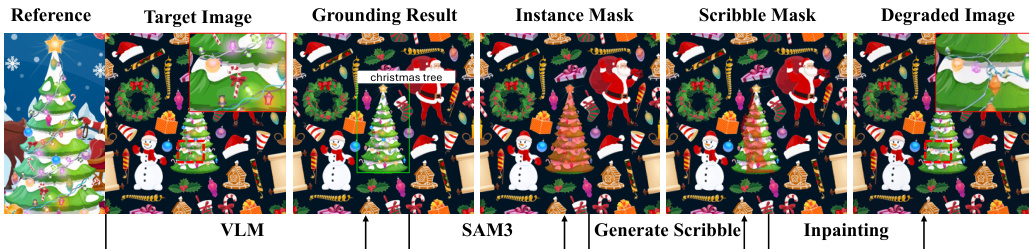
- Data Synthesis: For each case, the authors use inpainting via Flux-fill, SDXL, and Qwen-Edit to create degraded inputs within localized edit regions.
- Processing Pipeline: To ensure variety, the authors generate candidates using five random scribble masks across three different seeds for each inpainting method. They then manually select two representative degraded images per method to form the final evaluation set.
Method
The authors leverage a multimodal diffusion framework for localized image refinement, built upon the Qwen-Image architecture. The overall system, as illustrated in the framework diagram, consists of three primary components: a frozen multimodal encoder, a variational autoencoder (VAE), and a trainable diffusion backbone. The framework accepts an input image I, an optional reference image Iref, a user-provided scribble mask M indicating the edit region, and a text instruction y. The first component is a frozen Qwen2.5-VL encoder, which processes the input image, reference image (if provided), the scribble mask, and the text instruction to generate high-level multimodal conditioning tokens c. These tokens, defined by the equation c=Eϕ(I,Iref,M,y), capture the semantic and instructional intent of the task and are used to guide the denoising process through joint-attention mechanisms.
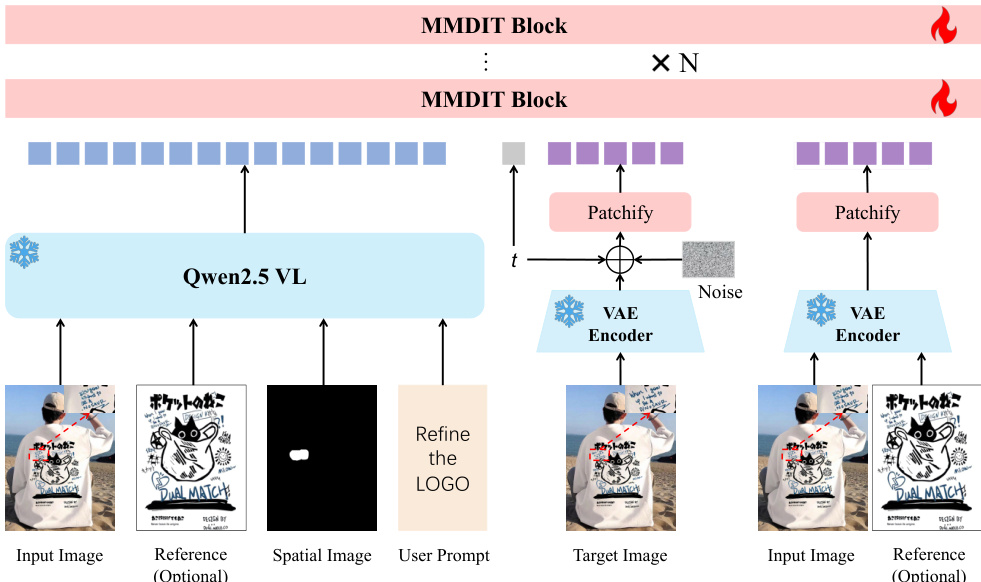
The second component is a VAE that encodes the input and optional reference images into latent representations zI and zref. These VAE latents provide low-level, fine-grained visual context, which is crucial for preserving the structural details of the image. During training, these latent representations are packed alongside the noisy target latent zt into patch token sequences and concatenated along the sequence dimension before being fed into the diffusion backbone.
The third component is the denoising backbone, which is built from MMDiT blocks, as shown in the framework diagram. This backbone iteratively removes noise from the target latent zt conditioned on both the multimodal tokens c and the VAE latent branches. At inference, the process begins with a noise latent zT, which is progressively denoised under a scheduler to produce z0. The final output image I is obtained by decoding z0 using the VAE decoder. The conditioning on the scribble mask M ensures that the refinement is localized to the specified region while the rest of the image is preserved.
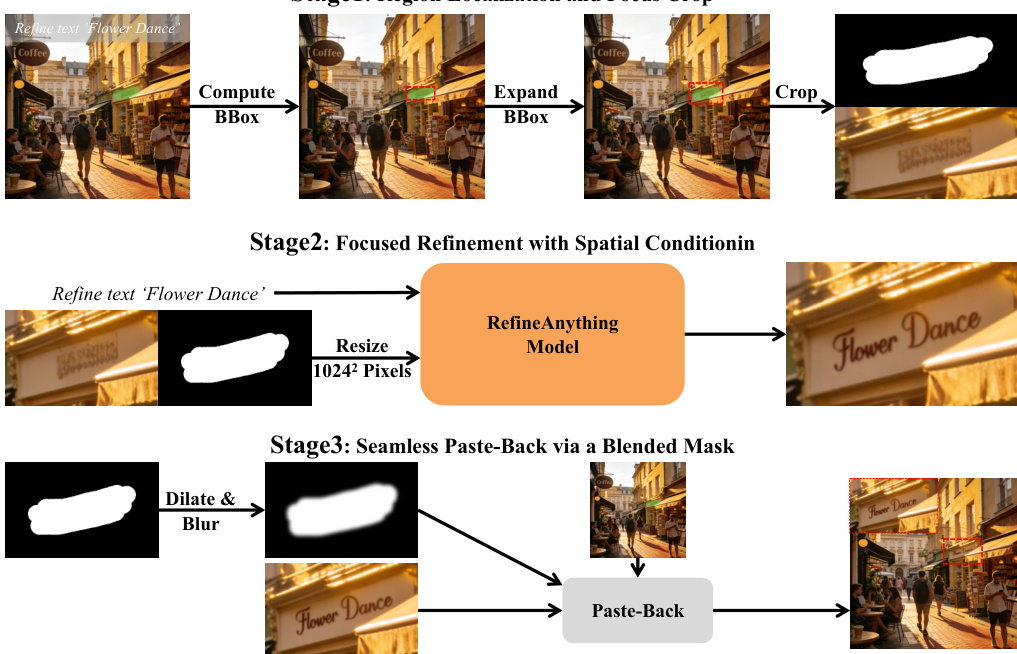
To address the challenge of limited resolution budget in local refinement, the authors introduce a Focus-and-Refine method. This method, illustrated in the overview diagram, consists of three stages. First, the region of interest is localized by computing a tight bounding box around the scribble mask and expanding it with a margin to create a focus crop. Second, the model performs focused generation on the cropped view, using the cropped scribble mask as a spatial cue and conditioning on the input, reference, and text instruction. This focused generation step is performed using the RefineAnything Model, which is the same architecture shown in the framework diagram. Third, to avoid visible seams, the refined crop is seamlessly pasted back into the original image using a blended mask. This blended mask is created by applying morphological dilation and Gaussian smoothing to the cropped mask, which is then used to composite the refined result with the original image.
To further enhance the naturalness of the paste-back, the authors employ a boundary consistency loss during training. This loss upweights supervision near the edit boundary to ensure smooth transitions. A boundary band Bc is defined by dilating the cropped mask and eroding it, and this band is used to weight the base loss map, which is the mean squared error between the predicted and target velocities in the latent space. The overall training objective is the expected value of the boundary-weighted loss.
Experiment
The evaluation utilizes the RefineEval benchmark to assess both reference-based and reference-free image refinement across metrics for edited-region fidelity and background preservation. Experiments validate the effectiveness of the Focus-and-Refine strategy and the Boundary Consistency Loss through ablation studies and comparisons with competitive baselines. Results demonstrate that the proposed method significantly improves local detail recovery and semantic alignment while maintaining near-perfect background consistency and seamless boundaries.
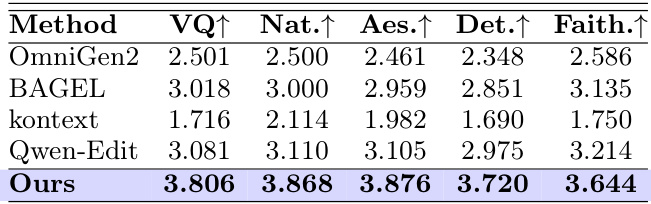
The authors evaluate their method against baselines on reference-free image refinement using a multi-dimensional scoring system. Results show that their approach achieves superior performance across all evaluation dimensions, outperforming existing models in visual quality, naturalness, aesthetics, detail fidelity, and instruction faithfulness. Our method outperforms all baselines on visual quality, naturalness, aesthetics, detail fidelity, and instruction faithfulness. The approach achieves the highest scores in all five evaluation dimensions compared to existing models. Results demonstrate strong performance in generating refined images that are both detailed and faithful to the input instructions.
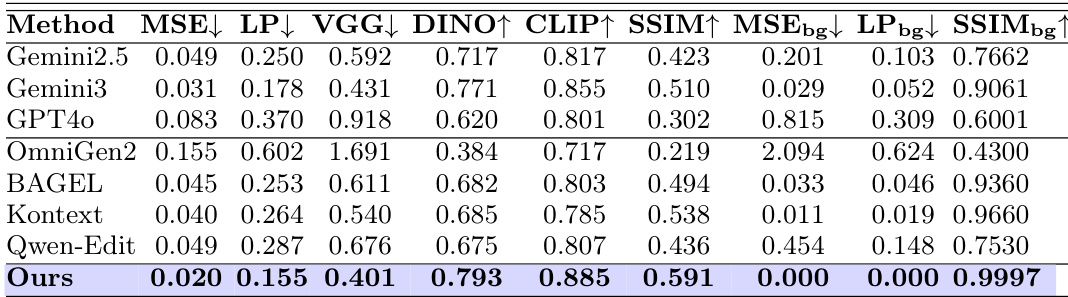
The authors evaluate their method against baselines on reference-based image refinement, focusing on region fidelity and background consistency. Results show that their approach achieves the best performance across multiple metrics, particularly in preserving the background and improving local detail accuracy. The proposed method outperforms baselines in both region fidelity and background preservation. It achieves near-perfect background consistency with minimal reconstruction errors. The method improves local detail recovery while maintaining strict background unchanged.

The authors evaluate their method against several baselines on reference-based image refinement, measuring both edited-region fidelity and background preservation. Results show that their approach achieves the best performance across multiple metrics, particularly in maintaining background consistency and improving local detail quality. Our method achieves the lowest error metrics for edited-region fidelity, including MSE and LPIPS. It maintains near-perfect background consistency, with minimal changes to non-target regions. The approach outperforms all baselines in both region fidelity and background preservation, demonstrating superior overall performance.
The authors evaluate their method through both reference-free and reference-based image refinement setups to assess visual quality and structural integrity. In reference-free scenarios, the approach demonstrates superior instruction faithfulness and aesthetic naturalness compared to existing baselines. For reference-based tasks, the method excels at recovering local details while maintaining near-perfect background consistency and region fidelity.