Command Palette
Search for a command to run...
L'Espace Latent : Fondements, Évolution, Mécanismes, Capacités et Perspectives
L'Espace Latent : Fondements, Évolution, Mécanismes, Capacités et Perspectives
Résumé
L'espace latent émerge rapidement comme un substrat natif pour les modèles fondés sur le langage. Bien que les systèmes modernes soient encore couramment compris à travers une génération explicite au niveau des tokens, un nombre croissant de travaux montre que de nombreux processus internes critiques s'effectuent plus naturellement dans un espace latent continu que dans des traces verbales lisibles par les humains. Ce changement est motivé par les limitations structurelles du calcul dans l'espace explicite, notamment la redondance linguistique, les goulots d'étranglement liés à la discrétisation, l'inefficacité séquentielle et la perte sémantique. Cette revue vise à fournir une vue d'ensemble unifiée et actualisée de l'espace latent dans les modèles fondés sur le langage. Nous organisons cette revue selon cinq perspectives séquentielles : Fondements, Évolution, Mécanismes, Capacités et Perspectives. Nous commençons par délimiter le périmètre de l'espace latent, en le distinguant de l'espace explicite ou verbal, ainsi que des espaces latents couramment étudiés dans les modèles génératifs visuels. Nous retraçons ensuite l'évolution du domaine, depuis les premières explorations jusqu'à l'expansion à grande échelle actuelle. Afin d'organiser le paysage technique, nous examinons les travaux existants à travers les lentilles complémentaires des mécanismes et des capacités. Du point de vue des mécanismes, nous identifions quatre axes majeurs de développement : l'architecture, la représentation, le calcul et l'optimisation. Du point de vue des capacités, nous montrons comment l'espace latent soutient un large spectre de compétences, couvrant le raisonnement, la planification, la modélisation, la perception, la mémoire, la collaboration et l'incarnation. Au-delà de la consolidation, nous discutons des défis ouverts clés et esquissons des directions prometteuses pour la recherche future. Nous espérons que cette revue servira non seulement de référence pour les travaux existants, mais aussi de fondement pour comprendre l'espace latent comme un paradigme général de calcul et de systèmes pour l'intelligence de nouvelle génération.
One-sentence Summary
Researchers from National University of Singapore, Fudan University, Tsinghua University, and other leading institutions propose a unified survey on latent space in language-based models, introducing a two-dimensional taxonomy of mechanisms and abilities to consolidate fragmented literature and guide future research in reasoning, perception, and embodied AI.
Key Contributions
- The paper introduces a unified survey framework organized around five sequential perspectives—Foundation, Evolution, Mechanism, Ability, and Outlook—to consolidate fragmented literature on latent space in language-based models.
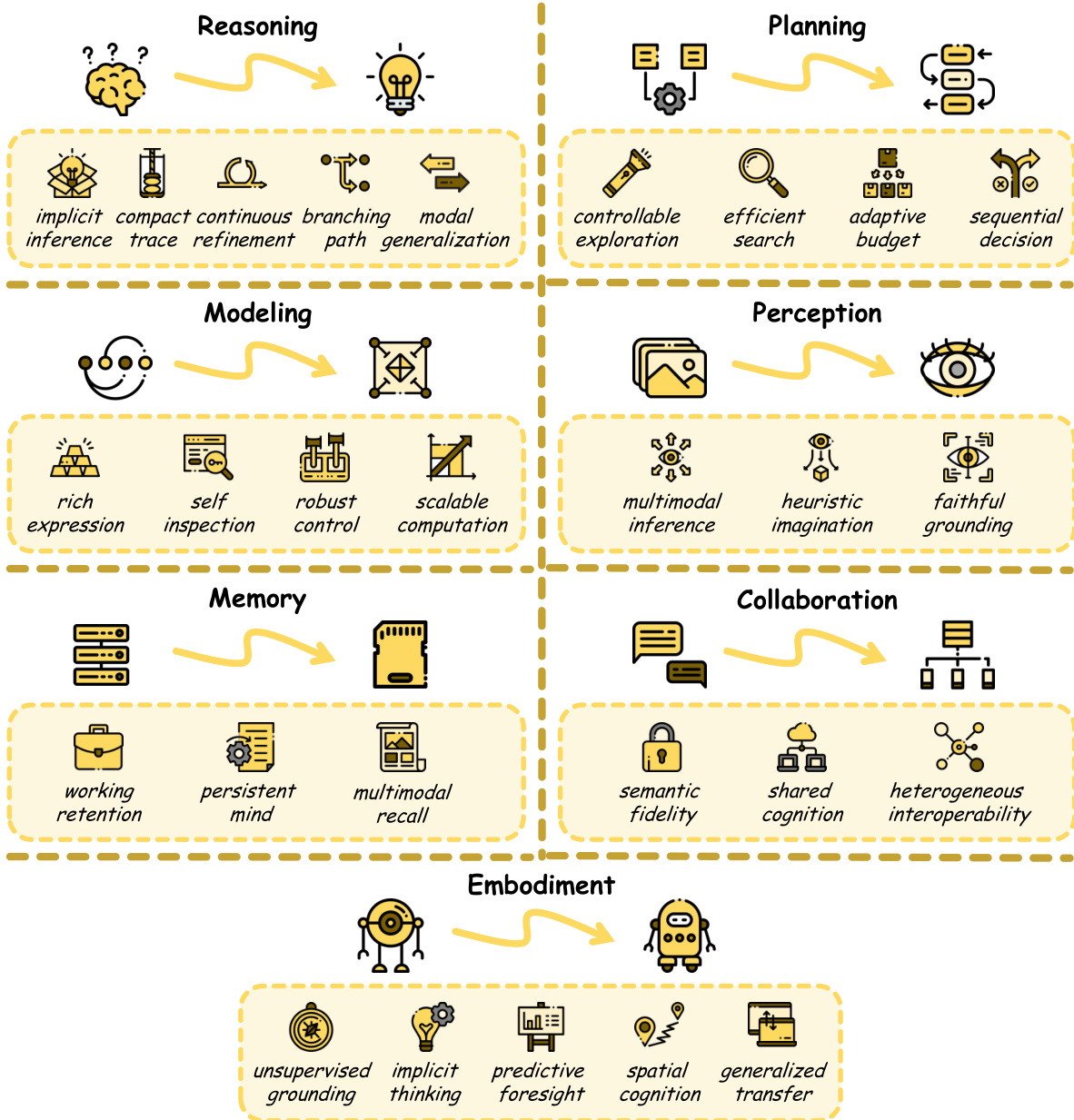
- This work presents a comprehensive technical taxonomy that classifies existing methods into four mechanism categories (Architecture, Representation, Computation, Optimization) and seven ability domains (Reasoning, Planning, Modeling, Perception, Memory, Collaboration, Embodiment).
- The study delineates the conceptual scope of latent space by distinguishing it from explicit token-level generation and visual generative models, while outlining open challenges and future research directions for next-generation intelligence.
Introduction
Language-based models are increasingly shifting from explicit token-level generation to continuous latent space as a native computational substrate, driven by the need to overcome linguistic redundancy, discretization bottlenecks, and sequential inefficiencies inherent in verbal traces. Prior research has largely remained fragmented across specific tasks like latent reasoning or visual understanding, lacking a unified framework to classify the diverse mechanisms and capabilities emerging in this field. The authors address this gap by providing a comprehensive survey that organizes the landscape into five sequential perspectives and introduces a two-dimensional taxonomy based on technical mechanisms and functional abilities to guide future research.
Method
The authors propose a unified framework to categorize how latent space is instantiated and operationalized within modern language-based systems. This mechanism-oriented taxonomy organizes diverse approaches along four complementary axes: Architecture, Representation, Computation, and Optimization. As illustrated in the framework diagram, these dimensions collectively define the design space for latent-space methods, clarifying how latent variables are constructed, processed, and refined.
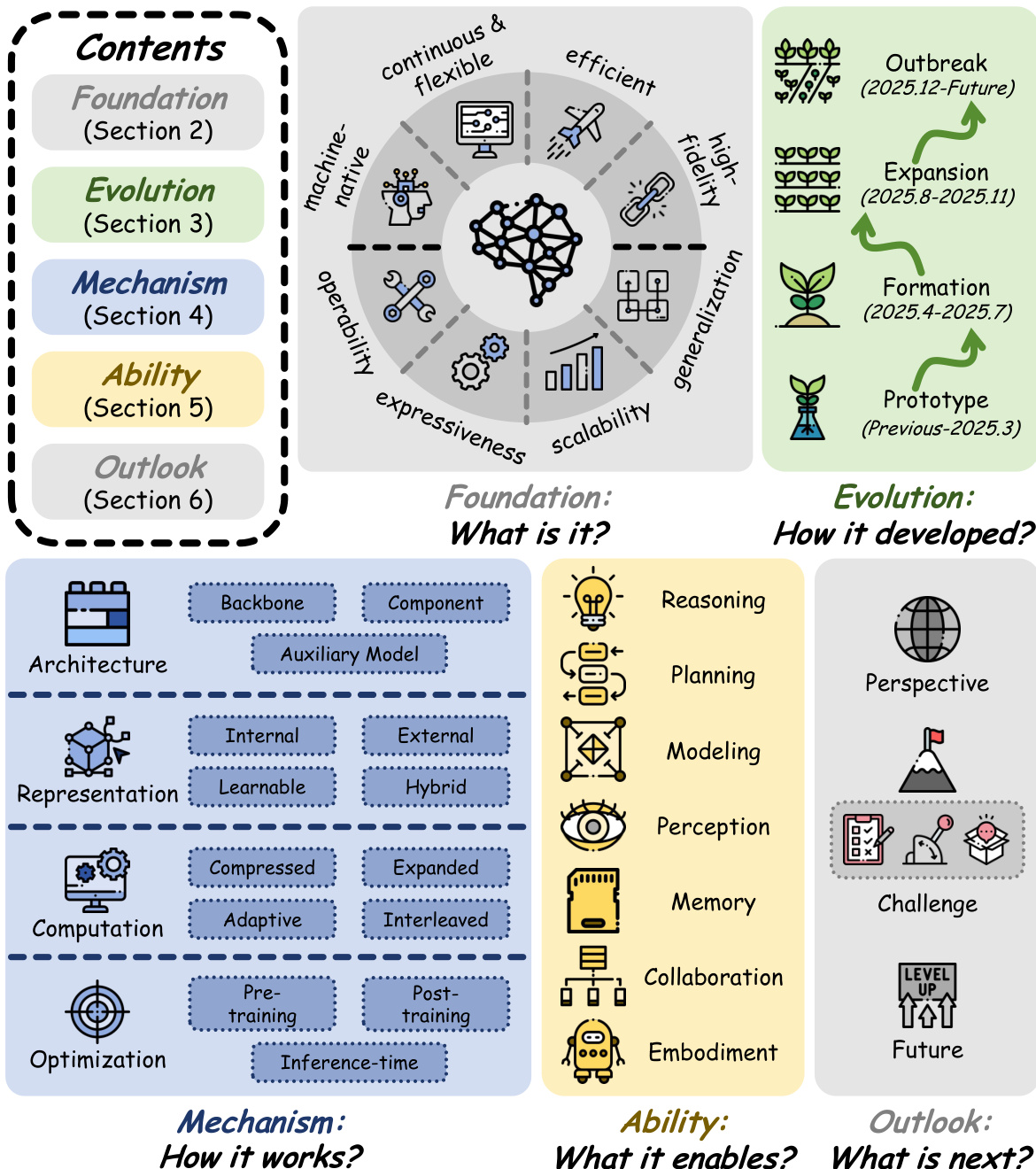
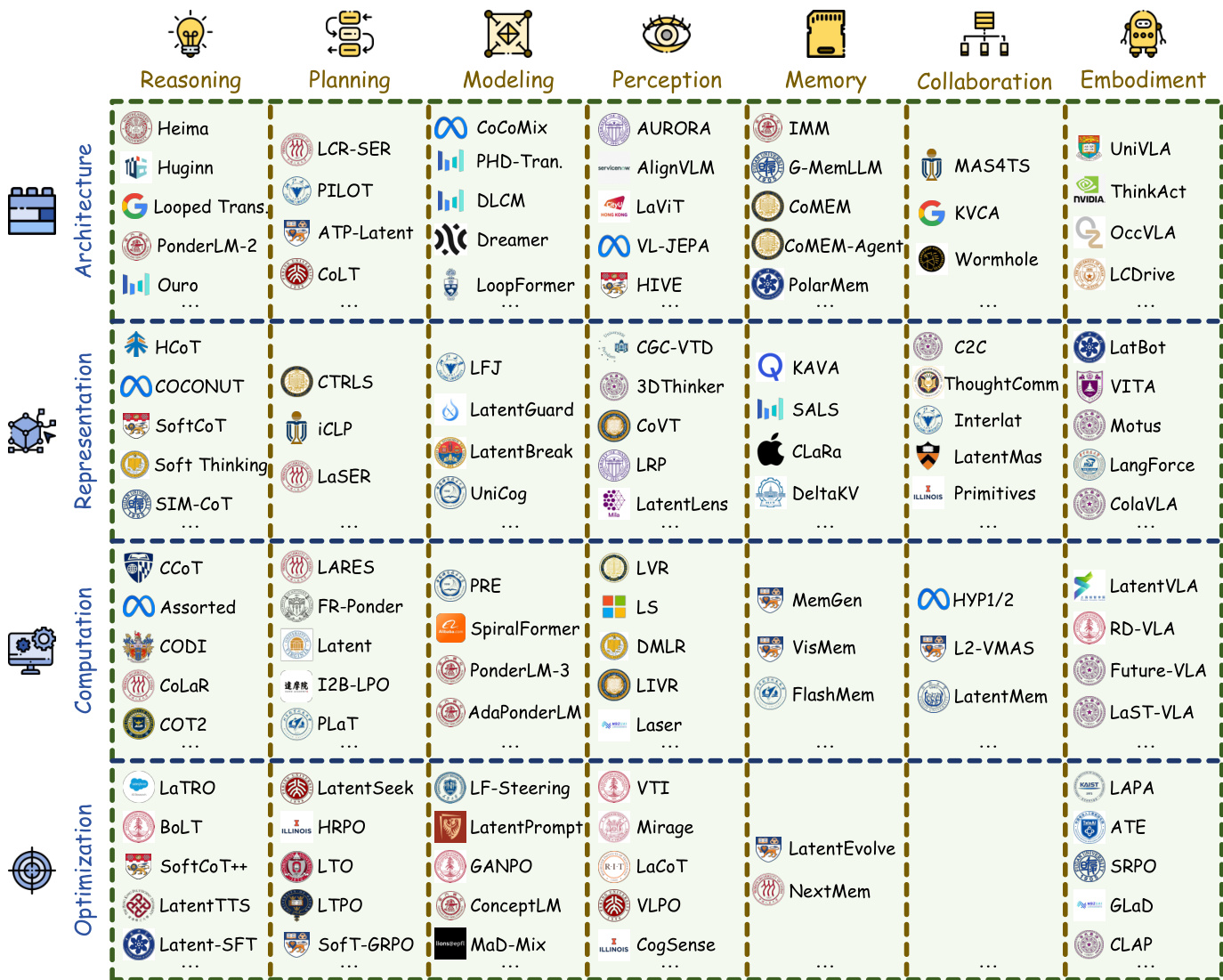
The architectural axis characterizes the structural role of latent space in the model. Methods are classified into three categories based on where latent computation is embedded. First, Backbone-based approaches endow the main model with native latent capacity through recurrent, looping, or recursive structures, making latent operation a primitive of the architecture itself. Second, Component-based methods preserve the original backbone but augment it with functional modules that construct, transform, store, or retrieve latent representations. Third, Auxiliary Model-based paradigms utilize an extra model to provide supervision signals or intermediate features to guide or supplement the host model. The taxonomy of representative works across these architectural choices is detailed in the grid diagram.
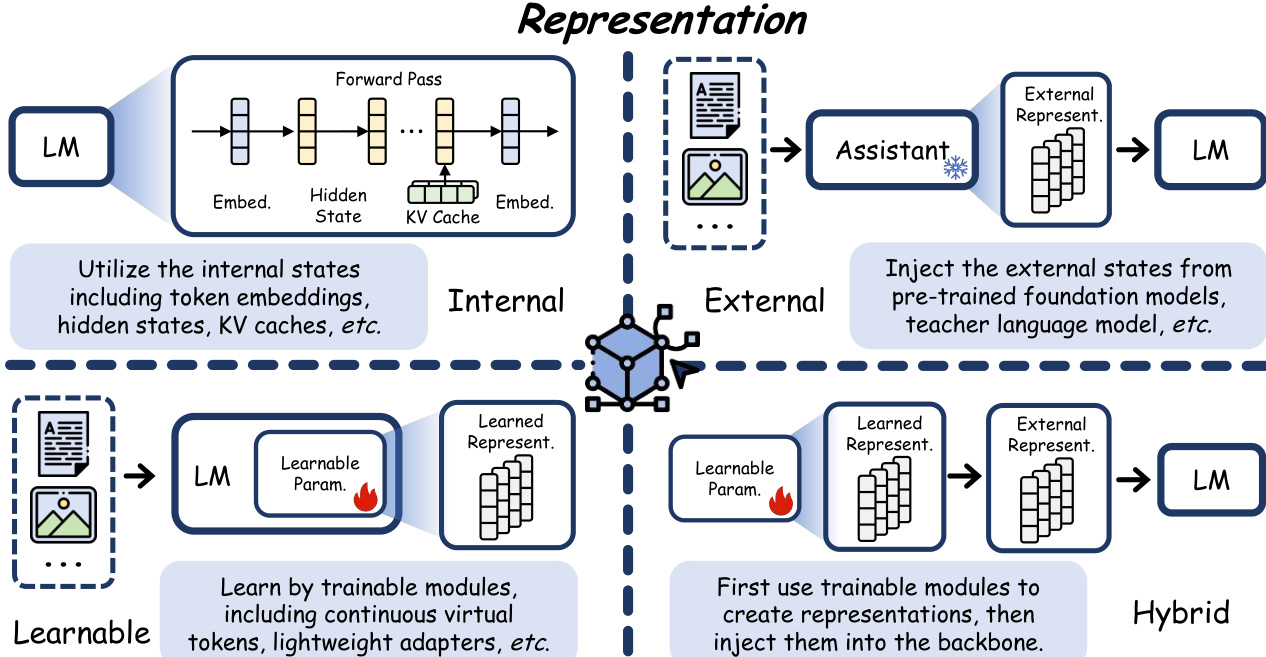
The representation axis describes the form of latent variables, distinguishing how information is encoded and integrated. Internal representations operate directly on activations produced during the backbone's forward pass, such as token embeddings or hidden states, without introducing additional parameters. External representations are derived from a structurally independent auxiliary system and injected into the backbone as conditioning inputs. Learnable representations are constructed by dedicated trainable modules embedded directly into the backbone and optimized end-to-end. Hybrid representations combine the Learnable and External paradigms by first using trainable modules to create specialized representations, then injecting them as exogenous signals. The schematic diagram illustrates these four sub-types and their data flow.
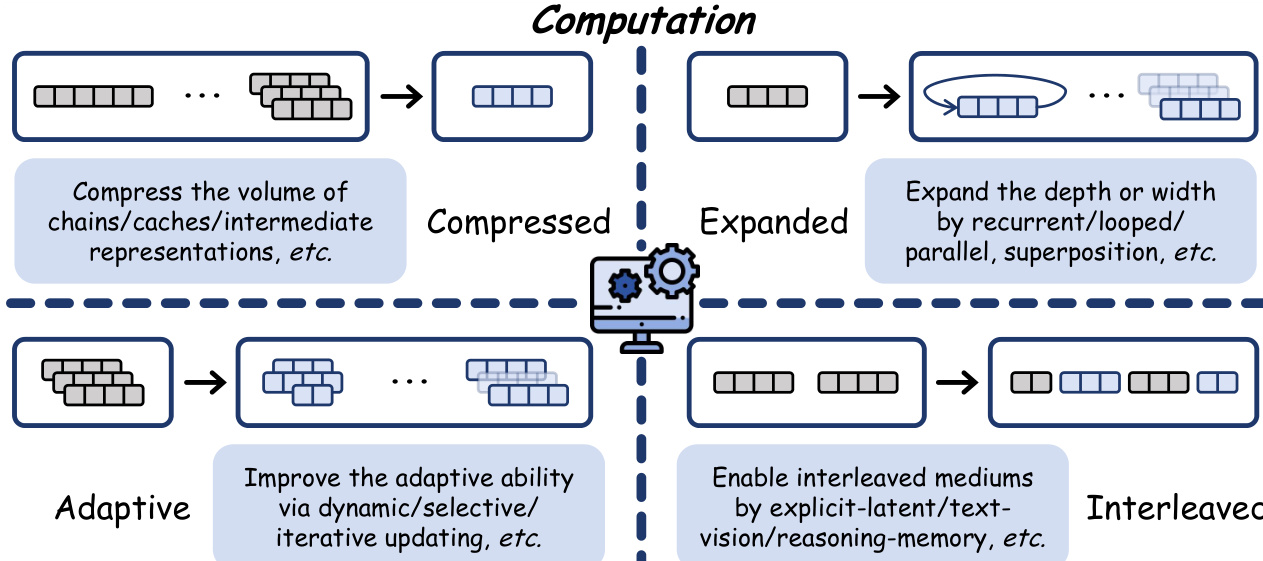
The computation axis captures how the latent space participates in information processing. Compressed computation reduces the volume of explicit traces or internal states to enhance efficiency while preserving expressiveness. Expanded computation increases effective capacity by extending latent processes along depth or width dimensions, such as through recurrent or parallel designs. Adaptive computation allocates resources dynamically based on input complexity, balancing capacity and efficiency flexibly. Interleaved computation bridges heterogeneous generation media, alternating between discrete tokens and continuous latents to combine explicit interpretability with implicit power. The corresponding schematic outlines these four computational strategies.
The optimization axis focuses on when and how latent space is induced, aligned, or refined. Pre-training methods start with a randomly initialized model and train it from scratch to enable native latent-level abilities. Post-training enhances the ability of pre-trained models using diverse supervision signals and objectives to learn the latent space. Inference-time methods focus on the manipulation of latent states during test time, allowing for dynamic adjustment without modifying model weights. The overview table summarizes the supervision, objective, and scenarios for each optimization stage.
Experiment
- A comparative analysis was conducted between the latent space and traditional explicit (verbal) space to clarify the unique characteristics of the latent representation.
- The experiment validates a paradigm shift in the representational properties and functional capabilities of language models when utilizing latent space versus explicit space.