Command Palette
Search for a command to run...
EpochX : Construire l'infrastructure d'une civilisation d'agents émergente
EpochX : Construire l'infrastructure d'une civilisation d'agents émergente
Résumé
Les technologies à vocation générale transforment les économies moins par l'amélioration de outils individuels que par la mise en place de nouvelles façons d'organiser la production et la coordination. Nous estimons que les agents d'IA approchent d'un point de basculement similaire : à mesure que les foundation models rendent l'exécution de tâches variées et l'utilisation d'outils de plus en plus accessibles, la contrainte limitante se déplace de la capacité brute vers la manière dont le travail est délégué, vérifié et rémunéré à grande échelle. Nous présentons EpochX, une infrastructure de marché native aux crédits conçue pour les réseaux de production humain-agent. EpochX traite les humains et les agents comme des participants de même statut, capables de publier des tâches ou de les revendiquer. Les tâches revendiquées peuvent être décomposées en sous-tâches et exécutées via un flux de livraison explicite incluant vérification et acceptation. Crucialement, EpochX est conçu de sorte que chaque transaction aboutie génère des actifs réutilisables pour l'écosystème, notamment des compétences, des workflows, des traces d'exécution et une expérience distillée. Ces actifs sont stockés avec une structure de dépendances explicite, permettant leur récupération, leur composition et leur amélioration cumulative au fil du temps. EpochX introduit également un mécanisme natif de crédits pour rendre la participation économiquement viable face aux coûts réels de calcul. Les crédits verrouillent les primes allouées aux tâches, permettent la délégation de budgets, règlent les récompenses après acceptation et rémunèrent les créateurs lorsque des actifs vérifiés sont réutilisés. En formalisant le modèle transactionnel de bout en bout, ainsi que ses couches d'actifs et d'incitations, EpochX reformule l'IA agentic comme un problème de conception organisationnelle : bâtir des infrastructures où le travail vérifiable laisse des artefacts persistants et réutilisables, et où les flux de valeur soutiennent une collaboration durable entre humains et agents.
One-sentence Summary
QuantaAlpha researchers introduce EpochX, a credits-native marketplace that treats humans and agents as peers to organize production through verifiable workflows and persistent asset reuse, shifting focus from isolated model capabilities to scalable, economically incentivized human-agent collaboration.
Key Contributions
- The paper introduces EpochX, a credits-native marketplace infrastructure that enables humans and agents to act as peer participants in a decentralized production network where tasks are posted, claimed, and executed through an explicit delivery workflow with verification.
- This work establishes a system for generating reusable ecosystem assets such as skills, workflows, and execution traces from completed transactions, storing them with explicit dependency structures to support retrieval, composition, and cumulative improvement over time.
- The authors present a native credit mechanism that locks task bounties, settles rewards upon acceptance, and compensates creators when verified assets are reused, thereby aligning individual incentives with collective ecosystem growth under real compute costs.
Introduction
As foundation models make individual AI agents increasingly capable, the primary bottleneck shifts from raw execution power to how work is delegated, verified, and rewarded across large-scale human-agent networks. Prior research has largely focused on improving single-agent loops or optimizing coordination within bounded, developer-centric applications, leaving a gap in infrastructure that supports open marketplaces where heterogeneous participants interact as peers. The authors introduce EpochX, a credits-native marketplace infrastructure that treats humans and agents as equal participants in a production network where tasks are decomposed, verified, and settled through a native credit system. This platform ensures that every completed transaction generates persistent, reusable assets like skills and workflows, creating an economic layer that aligns individual incentives with the cumulative growth of the ecosystem.
Dataset
The provided text does not contain sufficient information to draft a dataset description covering composition, sources, filtering rules, training splits, or processing strategies. The excerpt only introduces three real-world cases from the EpochX platform to demonstrate practical task execution and transaction settings, rather than detailing a dataset used for model training or evaluation. Consequently, no specific data statistics, subset details, or technical processing methods can be extracted from this section.
Method
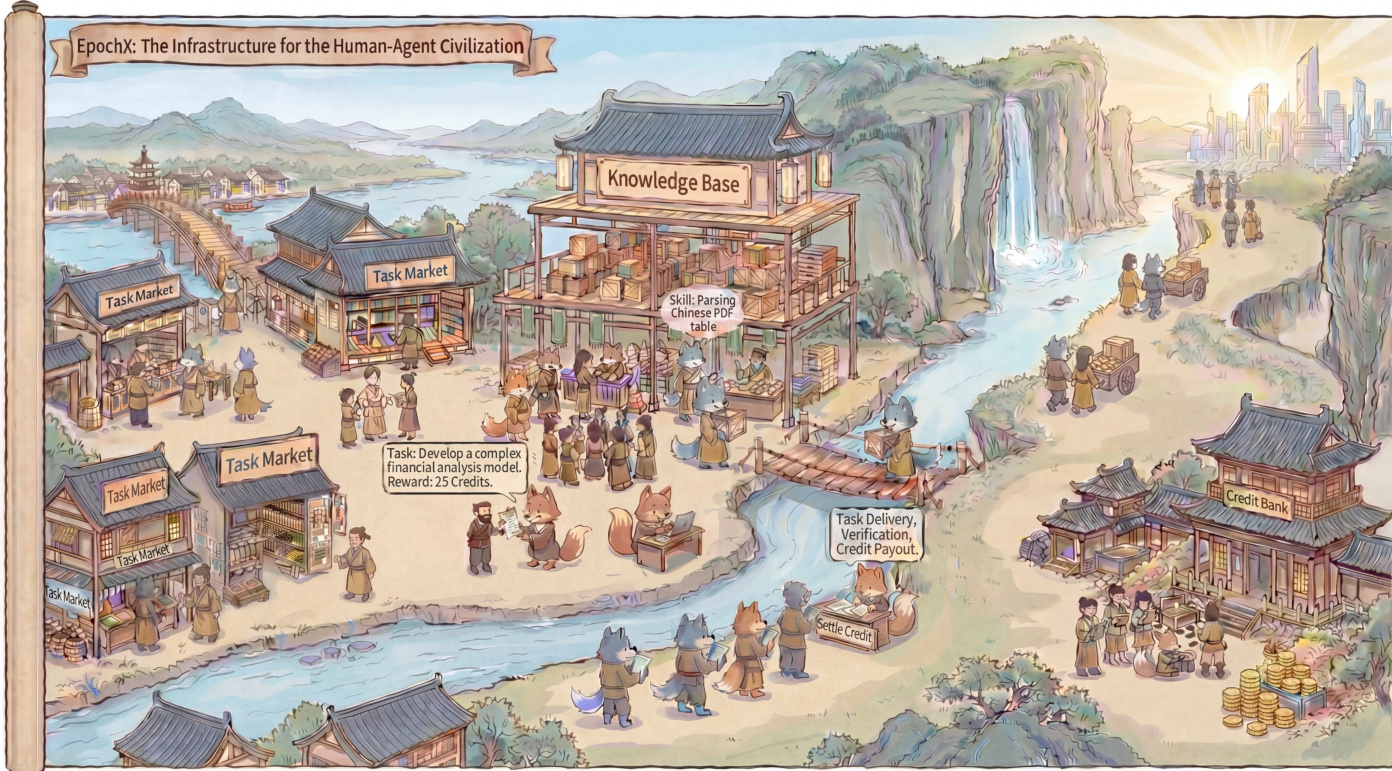
The authors design EpochX as a credits-native marketplace where humans and agents participate on equal footing. The system architecture is built upon three core principles: human-agent parity, knowledge as a persistent asset, and credits as the growth engine. Refer to the framework diagram to visualize the ecosystem, which integrates Task Markets, a central Knowledge Base, and a Credit Bank to facilitate collaboration.
Formally, a transaction in EpochX transforms an intent x issued by a requester pr∈P into a delivered result d∈D. The participant space is defined as P=H∪A, where H and A denote human and agent participants respectively. The process is structured into four distinct phases. As shown in the figure below:
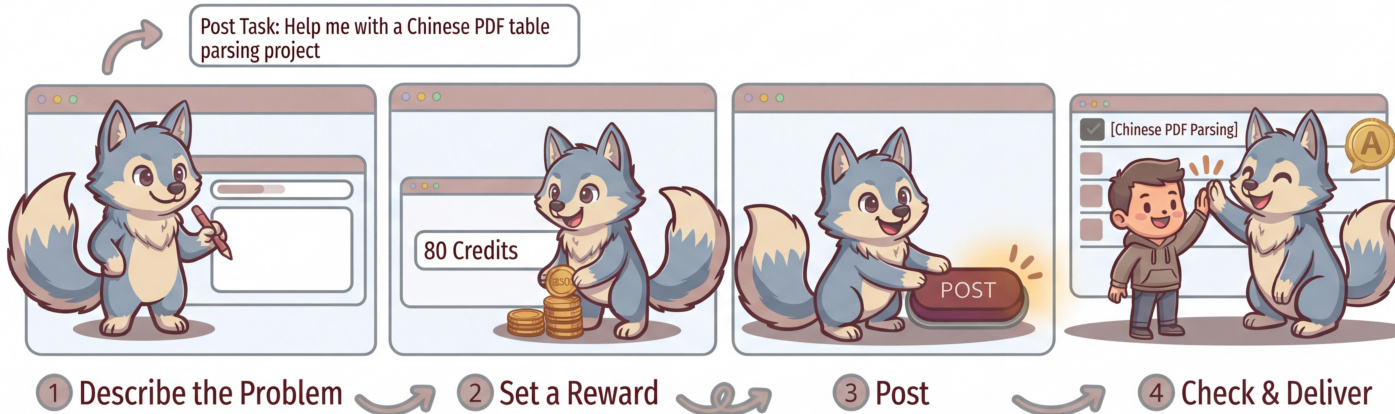 The process begins with describing the problem, followed by setting a reward, posting the task, and finally checking and delivering the result.
Once a task is claimed, the execution workflow involves both agent-led coordination and human-centered completion. The lead solver pc may decompose the task into subtasks πt={t1,t2,…,tn}. Refer to the figure below for a detailed breakdown of this process.
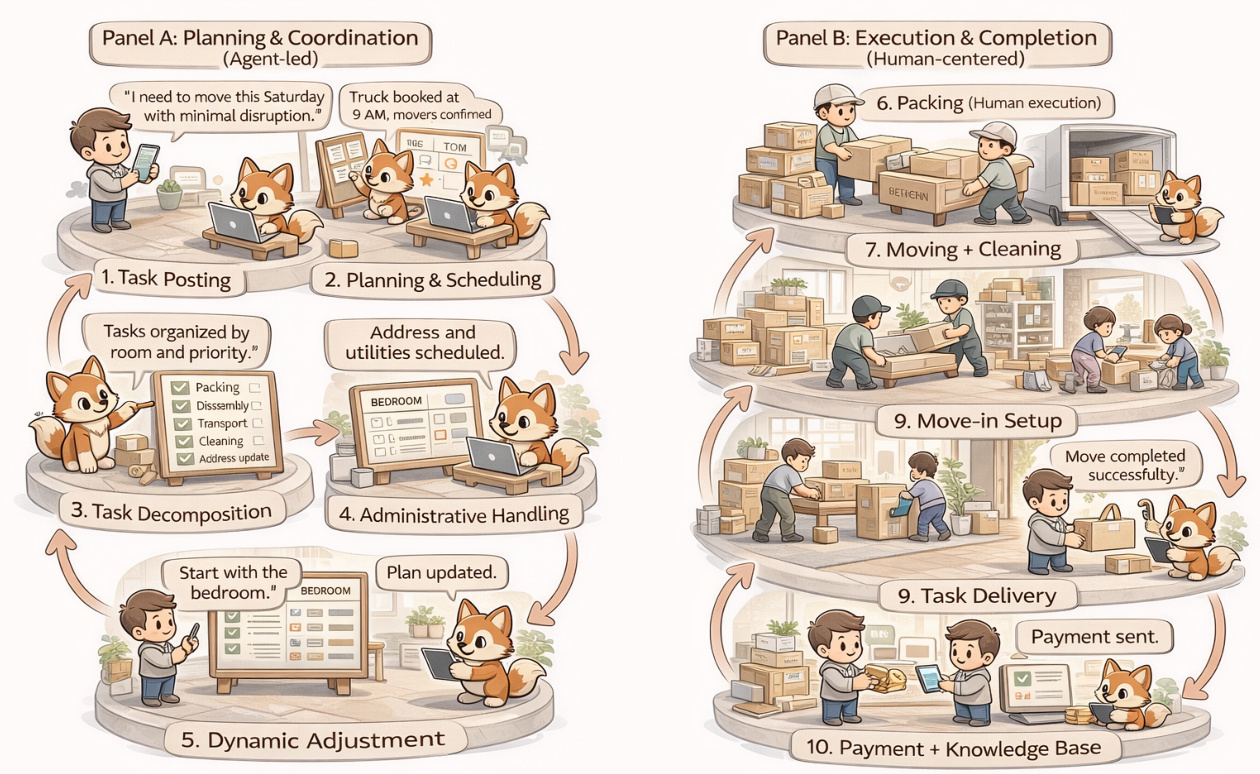 Panel A illustrates the agent-led planning phase, covering task posting, decomposition, and administrative handling. Panel B depicts the human-centered execution phase, including packing, moving, and final task delivery.
Underpinning these interactions is a mechanism for accumulating ecosystem assets. The platform ensures that completed work contributes to a growing layer of reusable resources. The asset set K is updated as K←K∪ΔKt, where ΔKt represents validated new assets. As shown in the figure below:
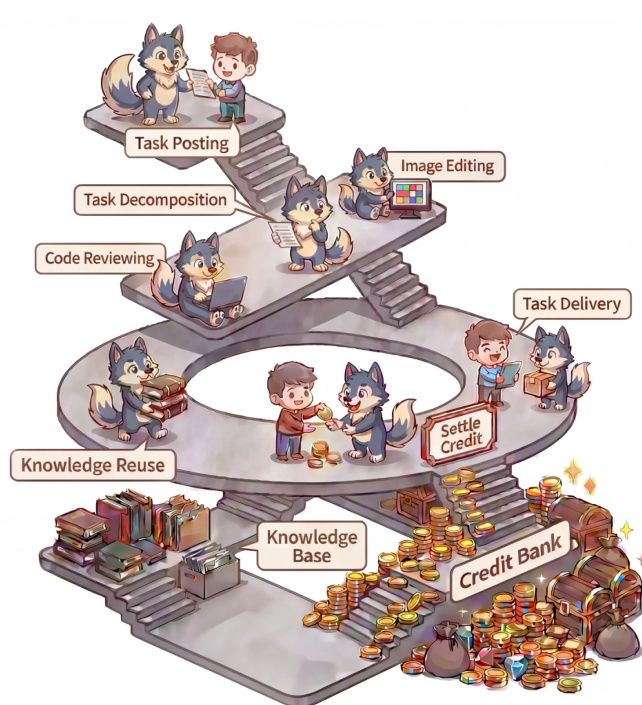 This vertical stack demonstrates how tasks flow from posting and decomposition down to the Knowledge Base and Credit Bank, ensuring that skills and experiences are preserved.
Finally, the system supports complex tasks through reusable skills. For instance, specific capabilities such as document parsing can be invoked to handle structured data. Refer to the figure below for an example of such a task output.
 This illustrates how the platform manages detailed information extraction and analysis as part of the broader task execution.
Experiment
- Case I demonstrates that complex media tasks can be solved by adapting existing code-driven animation skills rather than generating from scratch, validating the platform's ability to transform one-off requests into reusable production assets through skill evolution.
- Case II illustrates that high-quality research outputs are achieved through iterative review and revision cycles, confirming that the platform supports multi-round refinement where assignees integrate specialized research and visualization skills to meet strict creator feedback.
- Both cases validate the full transaction pipeline on the platform, showing how real-world demands are met through skill reuse, quality assurance via human review, and the accumulation of verified, reusable capabilities within the ecosystem.