Command Palette
Search for a command to run...
Économie des services d'IA en temps réel : un cadre pour le calcul agentic à travers le continuum
Économie des services d'IA en temps réel : un cadre pour le calcul agentic à travers le continuum
Lauri Lovén Alaa Saleh Reza Farahani Ilir Murturi Miguel Bordallo López Praveen Kumar Donta Schahram Dustdar
Résumé
Les services d'intelligence artificielle en temps réel fonctionnent de manière croissante à travers le continuum appareil-bord-cloud, où des agents autonomes génèrent des charges de travail sensibles à la latence, orchestrent des pipelines de traitement multi-étapes et rivalisent pour l'accès à des ressources partagées, le tout sous contraintes de politiques et de gouvernance. Cet article démontre que la structure des graphes de dépendance de services, modélisés comme des graphes acycliques dirigés (DAG) dont les nœuds représentent les étapes de calcul et dont les arêtes encodent l'ordre d'exécution, constitue un déterminant principal de la capacité d'une allocation de ressources décentralisée, fondée sur les prix, à fonctionner de manière fiable à grande échelle. Lorsque les graphes de dépendance sont hiérarchiques (arbres ou séries-parallèles), les prix convergent vers des équilibres stables, des allocations optimales peuvent être calculées efficacement et, sous une conception de mécanisme appropriée (avec des utilités quasi-linéaires et des éléments de tranches discrètes), les agents n'ont aucun incitatif à déclarer de manière stratégique leurs évaluations au sein de chaque epoch de décision. En revanche, lorsque les dépendances sont plus complexes, avec des liens transversaux entre les étapes du pipeline, les prix oscillent, la qualité de l'allocation se dégrade et le système devient difficile à gérer. Pour combler cette lacune, nous proposons une architecture de gestion hybride dans laquelle des intégrateurs inter-domaines encapsulent des sous-graphes complexes en tranches de ressources qui présentent une interface simplifiée et bien structurée au reste du marché. Une étude d'ablation systématique menée sur six expériences (1 620 exécutions, 10 graines aléatoires chacune) confirme que : (i) la topologie du graphe de dépendance est un déterminant de premier ordre de la stabilité des prix et de l'évolutivité ; (ii) l'architecture hybride réduit la volatilité des prix de 70 à 75 % sans compromettre le débit ; (iii) les contraintes de gouvernance génèrent des compromis quantifiables entre efficacité et conformité, dépendant conjointement de la topologie et de la charge ; et (iv) sous des enchères véridiques, le marché décentralisé atteint les performances d'une référence centralisée optimale en valeur, confirmant ainsi que la coordination décentralisée peut reproduire la qualité d'allocation d'une approche centralisée.
One-sentence Summary
Authors from the University of Oulu and other European institutions propose a hybrid management architecture that encapsulates complex service dependencies into polymatroidal slices, enabling stable, incentive-compatible decentralized resource allocation for real-time AI agents across the device-edge-cloud continuum.
Key Contributions
- Real-time AI services across the device-edge-cloud continuum face instability when complex service-dependency graphs create cross-resource complementarities that prevent price convergence and efficient allocation.
- The proposed hybrid management architecture encapsulates complex sub-graphs into resource slices to enforce hierarchical topologies, ensuring the feasible allocation set forms a polymatroid that guarantees market-clearing prices and truthful bidding.
- Systematic ablation studies across 1,620 runs demonstrate that this approach reduces price volatility by up to 75% without sacrificing throughput while matching the value-optimal quality of centralized baselines under truthful bidding.
Introduction
Real-time AI services increasingly operate across device-edge-cloud environments where autonomous agents must coordinate latency-sensitive workloads under strict governance constraints. Prior approaches struggle because centralized orchestration is impractical across trust boundaries, while naive decentralized markets fail when complex service dependencies create resource complementarities that destabilize prices and make optimal allocation computationally intractable. The authors leverage service-dependency graph topology to identify stable regimes where tree or series-parallel structures guarantee market equilibrium and truthful bidding, then propose a hybrid architecture that encapsulates complex sub-graphs into simplified resource slices to restore stability without sacrificing throughput.
Method
The authors propose a framework for distributed service computing where autonomous AI agents generate tasks, compose services, and interact economically across a continuum of devices, edge platforms, and cloud infrastructure. The system operates in discrete time periods t, with agents conditioning their valuations on a commonly accepted system state st. The overall model integrates agentic behavior, resource dependencies, governance constraints, and mechanism design to facilitate efficient allocation.
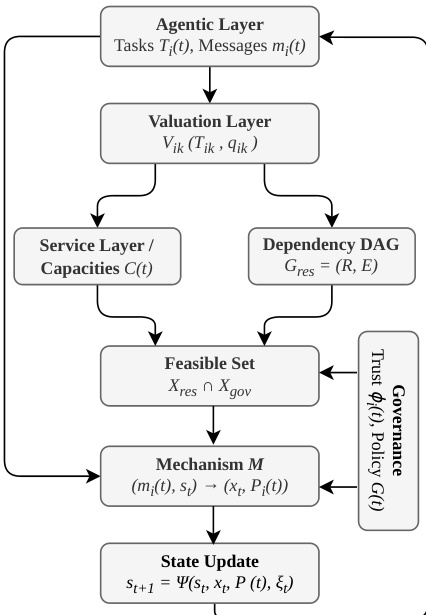
Refer to the framework diagram for a high-level overview of the system components and their interactions. The process begins at the Agentic Layer, where agents issue tasks Ti(t) and send messages mi(t). These inputs flow into the Valuation Layer, which computes latency-aware valuations defined as Vik(Tik,qik)=vik(qk)δik(Tik). Here, vik(q) represents the base value of completing a task at quality q, while δik captures latency decay. The valuation depends on the latency Tik and workload qk associated with the task.
Concurrently, the Service Layer defines available capacities C(t), while the Dependency DAG models structural dependencies among resources as Gres=(R,E). These factors converge at the Feasible Set, which is the intersection of resource constraints Xres and governance constraints Xgov. Governance inputs, including trust scores ϕ(t) and policies G(t), further restrict the feasible allocations. The Mechanism M then maps the messages and current state to an allocation xt and payments Pi(t). Finally, the State Update module evolves the system state according to st+1=Ψ(st,xt,P(t),ξt), incorporating exogenous events and realized allocations.
To ensure tractability in the presence of complex dependencies, the authors introduce a hybrid market architecture. As shown in the figure below, this architecture consists of three primary layers: Cross-Domain Integrators, Local Marketplaces, and AI Agents.
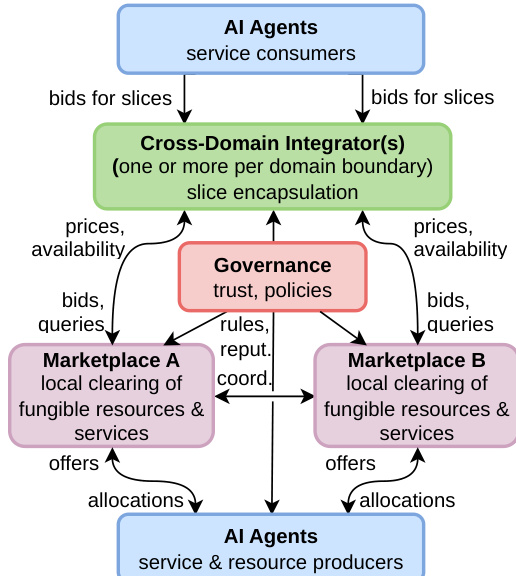
Cross-Domain Integrators form the agent-facing layer. Each integrator encapsulates a complex multi-resource service path into a governance-compliant slice. Internally, the integrator manages the dependency DAG of its sub-system and exposes a simplified, substitutable capacity interface. The capacity of this slice is set equal to the maximum flow of the internal sub-DAG. This encapsulation absorbs complementarities that would otherwise destabilize market-based coordination.
Beneath the integrators, Local Marketplaces operate at the device or edge scope to coordinate fungible services and resources, such as compute cycles and bandwidth. These markets clear via lightweight auctions or posted prices and enforce local governance policies. For simple, single-domain services, agents may interact directly with a local marketplace. Inter-Market Coordination ensures consistency through the exchange of coarse-grained signals, such as aggregate demand and congestion indicators, without requiring full system-wide optimization.
The mechanism design relies on the structural properties of the feasible allocation set. The authors demonstrate that when the service-dependency DAG is a tree or series-parallel network, the capacity constraints form a polymatroid. By using architectural encapsulation, the integrators ensure that the quotient graph seen by agents maintains this tree or series-parallel structure, even if the underlying infrastructure DAG is arbitrary. This preserves the polymatroidal structure of the agent-facing feasible region.
Furthermore, the latency-aware valuations satisfy the gross-substitutes (GS) condition under slice encapsulation. This is achieved because integrators expose discrete, indivisible slices with fixed internal routing and deterministic latency within each mechanism epoch. With a polymatroidal feasible set and GS valuations, the system admits a Walrasian equilibrium. Consequently, efficient allocation is computable in polynomial time via ascending auctions, and the outcome is implementable in a dominant-strategy incentive-compatible (DSIC) manner using mechanisms such as VCG or polymatroid clinching auctions.
Experiment
- Structural discipline experiments validate that polymatroidal topologies (tree and linear) ensure market stability with zero price volatility, whereas entangled dependency graphs cause severe degradation and market failure under high load.
- Hybrid architecture experiments confirm that encapsulating complex services into slices significantly reduces price volatility, with EMA smoothing acting as the primary stabilizer and efficiency factors improving latency and welfare in congested regimes.
- Governance experiments demonstrate that strict trust-gated capacity partitioning trades service coverage for quality by reducing latency, though it can induce price volatility in otherwise stable topologies due to smaller resource pools.
- Interaction studies reveal that the hybrid architecture effectively mitigates the volatility penalties introduced by strict governance, with synergy effects varying by topology from additive to super-additive.
- Market mechanism experiments show that under truthful bidding, price-based coordination yields welfare outcomes nearly identical to value-greedy allocation, indicating the mechanism's primary value lies in incentive alignment rather than informational superiority.