Command Palette
Search for a command to run...
MemSifter : Délégation de la récupération de mémoire des LLM par un raisonnement de proxy piloté par les résultats
MemSifter : Délégation de la récupération de mémoire des LLM par un raisonnement de proxy piloté par les résultats
Jiejun Tan Zhicheng Dou Liancheng Zhang Yuyang Hu Yiruo Cheng Ji-Rong Wen
Résumé
À mesure que les modèles de langage de grande taille (LLM) sont de plus en plus utilisés pour des tâches de longue durée, la préservation d'une mémoire à long terme efficace constitue un défi critique. Les méthodes actuelles se heurtent souvent à un compromis entre coût et précision : des stratégies de stockage simples échouent fréquemment à restituer les informations pertinentes, tandis que des méthodes d'indexation complexes (telles que les graphes de mémoire) exigent une charge computationnelle lourde et peuvent entraîner une perte d'information. De plus, faire appel au LLM opérationnel pour traiter l'intégralité des mémoires s'avère coûteux en calcul et lent.Pour surmonter ces limitations, nous proposons MemSifter, un cadre novateur qui délègue le processus de récupération de mémoire à un modèle proxy de petite taille. Au lieu d'alourdir la charge du LLM principal, MemSifter utilise un modèle réduit pour raisonner sur la tâche avant de récupérer les informations nécessaires. Cette approche ne requiert aucune computation lourde lors de la phase d'indexation et n'ajoute qu'une surcharge minimale lors de l'inférence.Afin d'optimiser le modèle proxy, nous introduisons un paradigme d'apprentissage par renforcement (RL) spécifique à la mémoire. Nous concevons une récompense orientée vers le résultat de la tâche, fondée sur la performance réelle du LLM opérationnel dans l'accomplissement de la tâche. Cette récompense évalue la contribution effective des mémoires récupérées grâce à des interactions multiples avec le LLM opérationnel et discrimine les classements de récupération selon une décroissance progressive de la contribution. Par ailleurs, nous mobilisons des techniques d'entraînement telles que l'apprentissage par curriculum (Curriculum Learning) et la fusion de modèles (Model Merging) pour améliorer les performances.Nous avons évalué MemSifter sur huit benchmarks dédiés à la mémoire des LLM, incluant des tâches de recherche approfondie (Deep Research). Les résultats démontrent que notre méthode atteint ou dépasse les performances des approches les plus avancées (state-of-the-art) existantes, tant en termes de précision de récupération que de réussite finale des tâches. MemSifter offre ainsi une solution efficace et évolutive pour la mémoire à long terme des LLM. Nous avons rendu publics les poids du modèle, le code source et les données d'entraînement afin de soutenir la recherche future.
One-sentence Summary
Researchers from Renmin University of China propose MemSifter, a framework that offloads memory retrieval to a small proxy model trained via outcome-driven reinforcement learning. This approach avoids heavy indexing costs while achieving state-of-the-art accuracy in long-term LLM memory tasks.
Key Contributions
- Long-duration LLM tasks face a critical trade-off where simple storage methods lack retrieval accuracy while complex indexing incurs heavy computation and information loss.
- MemSifter addresses this by offloading retrieval to a small-scale proxy model that reasons about tasks before fetching data, optimized via a novel outcome-driven Reinforcement Learning paradigm with marginal utility and rank-sensitive rewards.
- Evaluated on eight benchmarks including Deep Research tasks, the framework matches or exceeds state-of-the-art performance in retrieval accuracy and task completion while maintaining minimal inference overhead.
Introduction
As Large Language Models tackle increasingly long-duration tasks, maintaining effective long-term memory has become a critical bottleneck where existing solutions struggle to balance retrieval accuracy with computational cost. Prior approaches either rely on simple storage that misses relevant context or employ complex indexing structures like memory graphs that demand heavy computation and risk discarding vital details. Furthermore, forcing the primary working LLM to process all historical data creates a dual burden that slows down inference and increases expenses.
The authors introduce MemSifter, a framework that offloads the memory retrieval process to a specialized, lightweight proxy model to resolve this efficiency-accuracy trade-off. This proxy acts as an intelligent gatekeeper that reasons about task requirements before retrieving information, allowing the main LLM to focus solely on generation. To optimize this proxy without expensive annotations, the team develops a task-outcome-oriented Reinforcement Learning paradigm that uses the working LLM's final success as a reward signal. This approach combines marginal utility and rank-sensitive rewards to ensure the proxy learns to prioritize critical evidence, delivering state-of-the-art performance across multiple benchmarks while significantly reducing inference overhead.
Dataset
Dataset Overview
The authors curate a comprehensive evaluation suite comprising five personal LLM benchmarks and three deep research datasets to test long-term memory and complex reasoning capabilities.
-
Dataset Composition and Sources
- Personal LLM Benchmarks: The authors utilize LoCoMo (10 multimodal dialogues with ~300 turns), LongMemEval (continuous chatbot interactions), PersonaMem (180+ curated personas), PerM-V2 (1,000 simulated user scenarios), and ZH4O (mixed-context QA integrating semantic and episodic memory).
- Deep Research Benchmarks: The suite includes HotpotQA (multi-hop reasoning), WebWalker (systematic website traversal), and WebDancer (autonomous multi-step research).
- Custom Construction: A specialized "Deep Research" benchmark is built using search trajectories and reasoning traces sampled from the MiroVerse dataset.
-
Key Details and Filtering Rules
- Evaluation Sampling: For testing, the authors randomly sample 400 questions from the test sets of LoCoMo, PersonaMem, PersonaMem-v2, and PerLTQA.
- Specific Subset Sizing: The LongMemEval test set is reduced to a random sample of 150 questions.
- Difficulty Augmentation: The custom Deep Research benchmark applies two strict modifications to the original MiroVerse data:
- Noise Injection: Approximate search results containing semantically related but factually irrelevant details are added to force logical discrimination over keyword matching.
- Context Extension: Multiple search iterations and intermediate reasoning steps are concatenated to create significantly longer context windows.
-
Usage in Model Training and Evaluation
- The datasets serve primarily as evaluation benchmarks rather than training sources in this context.
- The authors use these subsets to stress-test retrieval-augmented generation systems, specifically evaluating their ability to sift through noisy search logs and extract precise evidence from massive context windows.
- The custom Deep Research environment is designed to differentiate advanced memory methods from standard baselines by requiring precise handling of misleading information.
-
Processing and Metadata Construction
- The custom benchmark construction involves synthesizing complex reasoning chains by merging multiple browsing trajectories.
- Metadata is enhanced by embedding semantic distractors that challenge the model's ability to maintain logical consistency.
- Case studies are generated for specific reasoning trajectories across LoCoMo, LongMemEval, and WebDancer to illustrate model performance on these complex tasks.
Method
.... * Image 3 (14913bea...): Shows the reward calculation process (Marginal Utility). * MemSifter selects sessions (S 27, S 15, etc.). * Working LLM (blue whale) processes "Sys + Task" -> Score 0. * "Sys + S 27 + Task" -> Score 1. * "Sys + S 27 + S 15 + Task" -> Score 2. * This visualizes the progressive evaluation strategy described in 3.3.1.
2. Structure the Section:
- Overview: Introduce MemSifter as a memory proxy.
- Architecture/Inference: Explain the "Think-and-Rank" process (referencing Image 1 and Image 2).
- Training/Reward: Explain the Task-Outcome-Oriented Reward (referencing Image 1 and Image 3).
- Marginal Utility (Ablation).
- Rank-Sensitive (DCG-like).
- Optimization: Briefly mention the iterative training and curriculum (from text).
3. Drafting Content - Step-by-Step:
- Introduction: The authors propose MemSifter, a memory proxy designed to retrieve relevant historical sessions for a working LLM.
- Inference/Architecture:
- Refer to Image 1 (top/bottom split). The bottom part shows inference.
- Refer to Image 2 for the prompt details.
- Explain the "Think-and-Rank" mechanism. The model takes history and current task, reasons about relevance, and outputs ranked session IDs.
- Training/Reward:
- Refer to Image 1 (top part "Memory RL"). This shows the RL loop.
- Refer to Image 3 for the reward calculation visualization.
- Explain the reward function. It's not just retrieval metrics; it's task outcome.
- Explain Marginal Utility: sk−sk−1.
- Explain Rank Sensitivity: Weighting based on position (DCG).
- Optimization: Mention the iterative process and curriculum learning.
4. Refining the Text (incorporating constraints):
- Constraint Check:
- Logical and readable? Yes.
- Reference images correctly?
- Image 1: Framework diagram (Memory RL + Inference).
- Image 2: Prompt details.
- Image 3: Reward calculation (Marginal Utility).
- Image annotation format:
on a separate line. - No image numbering in text (e.g., "Figure 1"). Use "Refer to the framework diagram".
- No conclusion.
- Professional tone.
- Math format: ... and ....
- No em dashes.
5. Drafting the specific text:
- Start: The proposed framework centers on MemSifter, a specialized memory proxy that mediates between a persistent memory bank and a working LLM.
- Inference: During inference, MemSifter processes the current task query alongside the historical interaction bank. As illustrated in the lower portion of the framework diagram, the model engages in a "Think-and-Rank" process. It first generates a reasoning rationale enclosed in
<think>tags to analyze dependencies, followed by a ranked list of session identifiers within<ranking>tags. The specific prompt structure guiding this behavior is detailed in the prompt diagram, which outlines strict criteria such as topic consistency and user need continuity to ensure high-quality retrieval. - Training/Reward: The training phase employs a Reinforcement Learning (RL) approach, depicted in the upper portion of the framework diagram. Unlike standard retrieval metrics, the authors leverage a task-outcome-oriented reward signal. This mechanism evaluates the retrieved memory based on its actual impact on the working LLM's final performance.
- Reward Details: To quantify this utility, the system employs a progressive evaluation strategy visualized in the reward calculation diagram. The process begins with a baseline score s0 obtained without memory. It then incrementally adds retrieved sessions (e.g., Session 27, then Session 15) to compute scores s1,s2,…. The marginal utility of each added segment is calculated as the performance lift Δsn=skn−skn−1.
- Rank Sensitivity: To prioritize critical information, the reward function incorporates a rank-sensitive component analogous to the DCG metric. The final reward Rans is formulated as a weighted sum of accumulated scores: Rans=−s0+∑n=1Nwn⋅skn where weights wn decay logarithmically to ensure that performance gains from top-ranked memories contribute more significantly to the total reward.
- Optimization: The optimization protocol utilizes an iterative training strategy with a dynamic curriculum. To stabilize the early stages of training, a hybrid reward is used, combining the outcome-based reward with a temporary retrieval quality metric before annealing to purely outcome-oriented optimization.
6. Final Review against constraints:
- Image 1 used? Yes (framework diagram).
- Image 2 used? Yes (prompt diagram).
- Image 3 used? Yes (reward calculation diagram).
- Math correct? Yes.
- No em dashes? Checked.
- No section refs? Checked.
7. Final Polish: Ensure smooth transitions between paragraphs. Make sure the image captions are descriptive enough for the context.
- Image 1 Caption: "Overview of the Memory RL framework and MemSifter inference process."
- Image 2 Caption: "Prompt template for the memory proxy model detailing input definitions and output requirements."
- Image 3 Caption: "Visualization of the marginal utility reward calculation via progressive ablation."
Let's assemble.
Self-Correction on Image 1: The prompt asks to reference images. I need to make sure I don't number them. I will refer to them by their content description.
- Image 1: "Refer to the framework diagram"
- Image 2: "As shown in the prompt diagram"
- Image 3: "As illustrated in the reward calculation diagram"
Wait, I need to check the image paths provided in the prompt.
store/2603.03379/tex_resource/monkeyocr/images/4928b5990c954036a5532917687d42d25d2656a0d929485ab1fbf3d8832fa7af.jpg(Framework)store/2603.03379/tex_resource/monkeyocr/images/5182ab4625115af94ec63cffc278cb6c505733bf243614418a196e41cbf5315e.jpg(Prompt)store/2603.03379/tex_resource/monkeyocr/images/14913beac670fff2acddf4ded4b361b22dea4abdcee491a392c7a4efd5abd618.jpg(Reward Calc)
Okay, ready to write.
The proposed framework centers on MemSifter, a specialized memory proxy designed to mediate between a persistent memory bank and a working LLM. The system operates through a distinct inference phase and a reinforcement learning-based training loop.
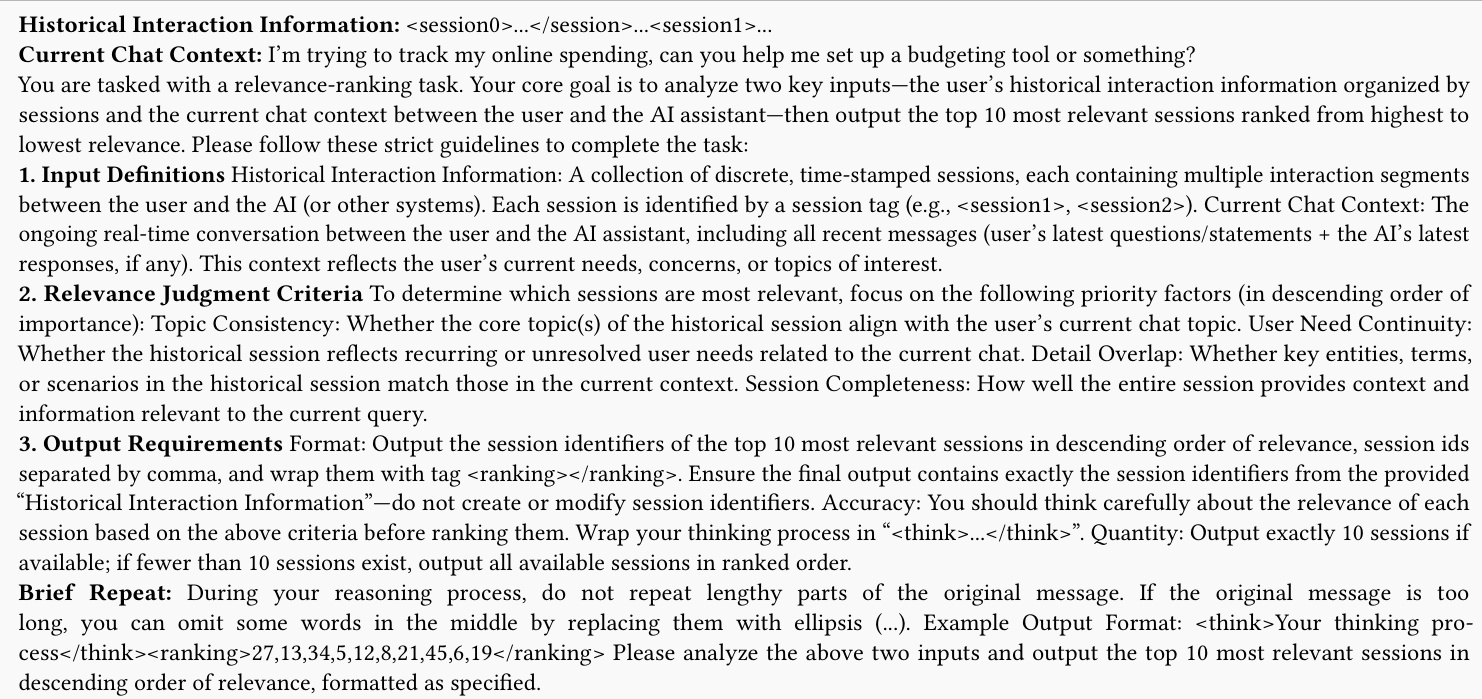
During the inference phase, MemSifter processes the current task query alongside the historical interaction bank. As illustrated in the lower portion of the framework diagram, the model engages in a "Think-and-Rank" process. It first generates a reasoning rationale enclosed in <think> tags to analyze dependencies, followed by a ranked list of session identifiers within <ranking> tags. The specific prompt structure guiding this behavior is detailed in the prompt diagram, which outlines strict criteria such as topic consistency, user need continuity, and detail overlap to ensure high-quality retrieval. The retrieved sessions are then concatenated with the current task to form the context for the working agent.
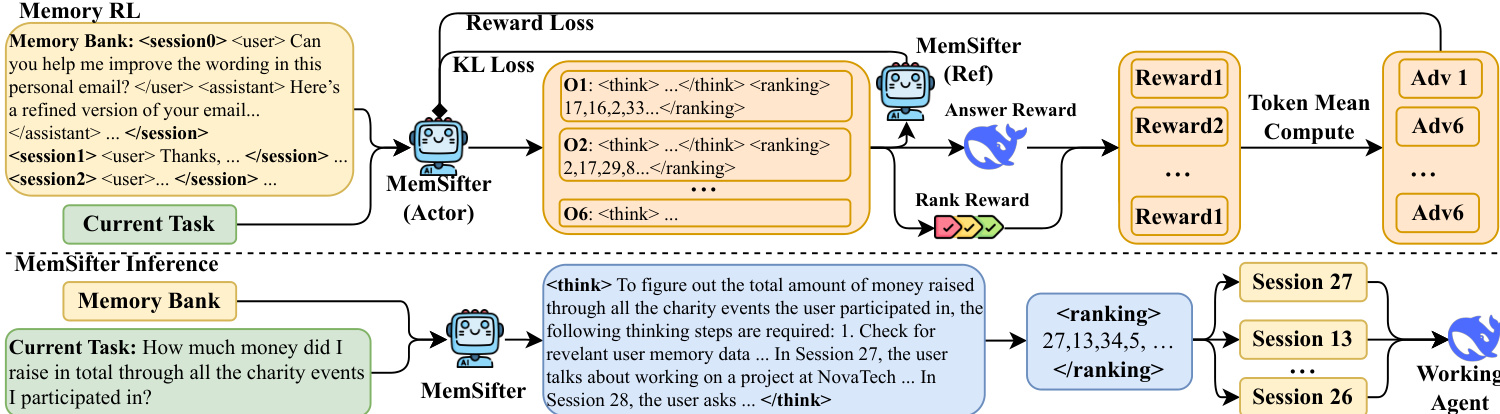
The training phase employs a Reinforcement Learning (RL) approach, depicted in the upper portion of the framework diagram. Unlike standard retrieval metrics, the authors leverage a task-outcome-oriented reward signal. This mechanism evaluates the retrieved memory based on its actual impact on the working LLM's final performance rather than intrinsic retrieval quality. To quantify this utility, the system employs a progressive evaluation strategy visualized in the reward calculation diagram. The process begins with a baseline score s0 obtained without memory. It then incrementally adds retrieved sessions (e.g., Session 27, then Session 15) to compute scores s1,s2,…. The marginal utility of each added segment is calculated as the performance lift Δsn=skn−skn−1.
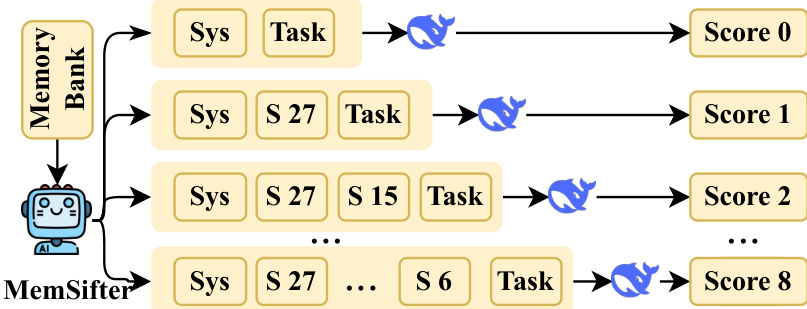
To prioritize critical information, the reward function incorporates a rank-sensitive component analogous to the DCG metric. The final reward Rans is formulated as a weighted sum of accumulated scores:
Rans=−s0+∑n=1Nwn⋅skn
where weights wn decay logarithmically to ensure that performance gains from top-ranked memories contribute more significantly to the total reward. The optimization protocol utilizes an iterative training strategy with a dynamic curriculum. To stabilize the early stages of training, a hybrid reward is used, combining the outcome-based reward with a temporary retrieval quality metric before annealing to purely outcome-oriented optimization.
Experiment
- MemSifter is evaluated against diverse baselines including embedding retrieval, memory frameworks, graph-based reasoning, generative rerankers, and native long-context LLMs, demonstrating superior task success rates by filtering noise and prioritizing information with high task utility rather than just semantic similarity.
- The method proves more efficient than complex graph-based pipelines and long-context models, achieving state-of-the-art performance with a lightweight architecture that mitigates the "lost-in-the-middle" phenomenon while significantly reducing computational costs.
- Ablation studies confirm that the task-outcome reward mechanism is critical for downstream utility, as optimizing solely for static relevance fails to capture logically crucial memories, while rank-sensitive weighting and marginal utility metrics are essential for accurate credit assignment and training stability.
- Further analysis reveals that MemSifter achieves higher recall and ranking precision than reasoning-heavy baselines, converges faster through outcome-oriented rewards, and avoids performance plateaus via curriculum learning that adapts to the model's evolving capabilities.
- Case studies illustrate the model's ability to explicitly reason about task dependencies to filter distractions and pinpoint critical memory segments, validating its effectiveness in real-world scenarios.