Command Palette
Search for a command to run...
Forçage de contexte : génération vidéo autoregressive cohérente avec un long contexte
Forçage de contexte : génération vidéo autoregressive cohérente avec un long contexte
Shuo Chen Cong Wei Sun Sun Ping Nie Kai Zhou Ge Zhang Ming-Hsuan Yang Wenhu Chen
Résumé
Les approches récentes de génération vidéo en temps réel à longue durée s'appuient généralement sur des stratégies d'ajustement en flux (streaming tuning), visant à entraîner un modèle étudiant à longue portée à partir d'un modèle enseignant à courte portée (sans mémoire). Dans ces cadres, l'étudiant effectue des prédictions sur de longues séquences, mais reçoit une supervision provenant d'un enseignant limité à des fenêtres courtes de 5 secondes. Ce décalage structurel entraîne un problème critique de désalignement entre l'enseignant et l'étudiant : l'incapacité de l'enseignant à accéder à l'historique à long terme lui interdit de guider l'étudiant sur les dépendances temporelles globales, ce qui limite effectivement la longueur de contexte atteignable par ce dernier. Pour résoudre ce problème, nous proposons Context Forcing, un cadre novateur qui entraîne un modèle étudiant à longue portée à l’aide d’un modèle enseignant également à longue portée. En garantissant que l’enseignant soit pleinement conscient de l’historique complet de génération, nous éliminons le déséquilibre de supervision, permettant ainsi un entraînement robuste de modèles capables de maintenir une cohérence à long terme. Pour rendre cette approche computationnellement viable sur des durées extrêmes (par exemple, 2 minutes), nous introduisons un système de gestion du contexte qui transforme le contexte croissant linéairement en une architecture de mémoire Slow-Fast, réduisant ainsi significativement la redondance visuelle. Des résultats étendus montrent que notre méthode permet d’atteindre des longueurs de contexte efficaces dépassant 20 secondes — soit deux à dix fois plus longues que les méthodes de pointe actuelles telles que LongLive ou Infinite-RoPE. En exploitant cette extension du contexte, Context Forcing préserve une cohérence supérieure sur de longues durées, dépassant les meilleures solutions existantes sur diverses métriques d’évaluation vidéo longue.
One-sentence Summary
Shuo Chen, Cong Wei, and colleagues from UC Merced and Tsinghua propose Context Forcing, a framework using long-context teachers to train students for 20s+ video generation, overcoming forgetting-drifting via Slow-Fast Memory, outperforming LongLive and Infinite-RoPE in long-term consistency.
Key Contributions
- We identify and resolve a critical student-teacher mismatch in long video generation, where short-context teachers fail to supervise long-context students on global temporal dependencies, by introducing Context Forcing—a framework that trains students using long-context teachers aware of full generation history.
- To enable computationally efficient training for extreme durations (e.g., 2 minutes), we design a Slow-Fast Memory architecture that compresses linearly growing context by reducing visual redundancy, allowing stable training and inference with 20+ seconds of effective context.
- Evaluated on long video benchmarks, Context Forcing achieves 2–10× longer usable context than state-of-the-art methods like LongLive and Infinite-RoPE, significantly improving long-term consistency and outperforming baselines on key temporal coherence metrics.
Introduction
The authors leverage causal video diffusion models to tackle the challenge of generating long, temporally consistent videos—critical for applications like digital storytelling and professional editing—where prior methods suffer from either forgetting past context or drifting due to error accumulation. Existing approaches rely on short-context teachers to train long-context students, creating a mismatch that limits learnable temporal dependencies and forces a trade-off between memory and stability. Their main contribution is Context Forcing, a framework that trains a long-context student using a long-context teacher, eliminating this mismatch and enabling robust generation over 20+ seconds via a Slow-Fast Memory architecture that compresses redundant visual information while preserving global coherence.
Method
The authors leverage a two-stage curriculum within a causal autoregressive framework to train a long-context video diffusion model capable of maintaining temporal consistency over extended durations. The overall objective is to minimize the global KL divergence between the student’s induced distribution pθ(X1:N) and the real data distribution pdata(X1:N), where N spans tens to hundreds of seconds. Direct optimization of this global objective is computationally infeasible, so the authors decompose it into local dynamics Llocal and global continuation dynamics Lcontext, enabling a tractable, staged training procedure.
In Stage 1, the student is warmed up by minimizing Llocal, which aligns the distribution of short video windows X1:k (typically 1–5 seconds) with a high-quality teacher distribution pT(X1:k). This is achieved via Distribution Matching Distillation (DMD), where gradients are estimated using score matching between the student and teacher models on diffused versions of generated frames. This stage ensures the student generates high-fidelity short sequences, providing stable context for the subsequent stage.
Stage 2 targets Lcontext, which enforces alignment between the student’s continuation pθ(Xk+1:N∣X1:k) and the true data continuation pdata(Xk+1:N∣X1:k). Since the true data continuation is inaccessible for arbitrary student-generated contexts, the authors introduce a pretrained Context Teacher T that provides a reliable proxy pT(Xk+1:N∣X1:k). This is justified under two assumptions: (1) the teacher remains accurate when conditioned on contexts near the real data manifold, and (2) Stage 1 ensures the student’s rollouts remain within this reliable region. The resulting Contextual DMD (CDMD) objective is optimized using a conditional score-based gradient estimator, where both student and teacher scores are computed on the same student-generated context, mitigating exposure bias.
To handle the computational burden of long contexts, the authors design a Context Management System that organizes the KV cache into three functional components: an Attention Sink, Slow Memory, and Fast Memory. The Attention Sink retains initial tokens to stabilize attention, while Fast Memory acts as a rolling FIFO queue for immediate local context. Slow Memory stores high-entropy keyframes selected via a surprisal-based consolidation policy: a new token xt is promoted to Slow Memory if the similarity between its key vector kt and the preceding key kt−1 falls below a threshold τ, ensuring only salient temporal transitions are retained. This architecture enables efficient context retention without linear growth in memory or attention cost.
Refer to the framework diagram, which illustrates the evolution from short-context to long-context training with memory management. The diagram shows how the student progressively learns to generate longer sequences by leveraging the teacher’s supervision and the structured memory system. The memory components are dynamically updated: Fast Memory slides through recent frames, while Slow Memory compresses salient events into a fixed-size buffer. Bounded positional encoding is applied to all tokens, constraining their RoPE indices to a fixed range regardless of generation step, thereby stabilizing attention over long sequences.
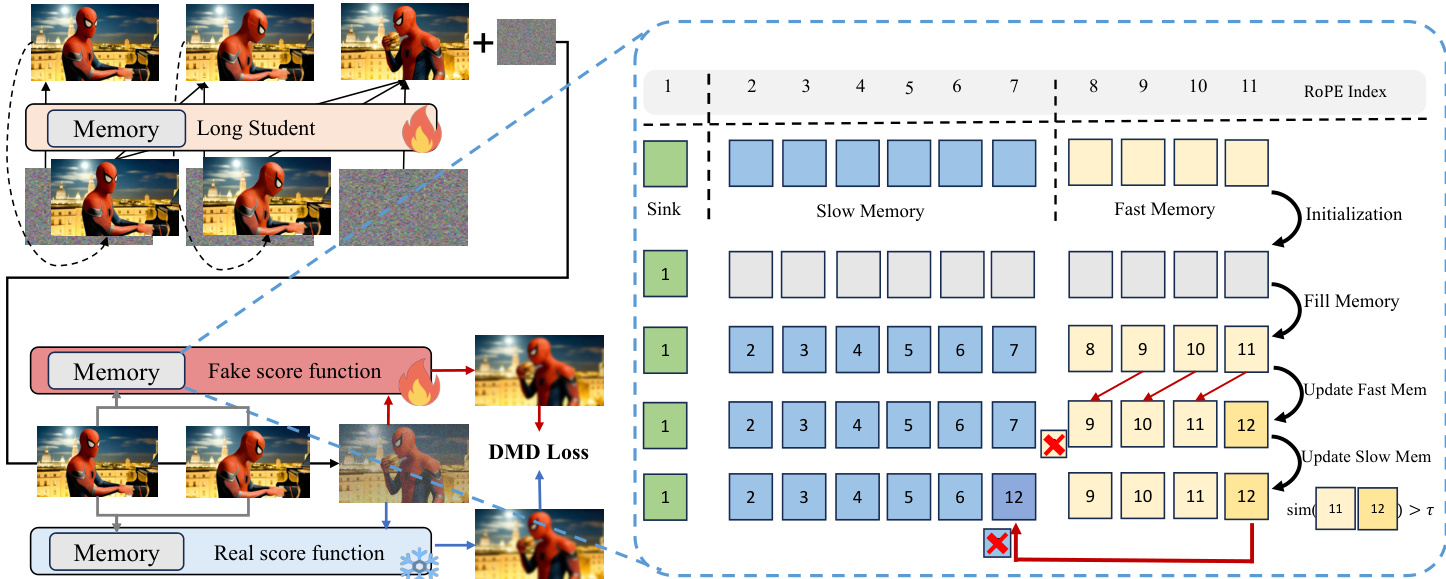
The training process further incorporates a Long Self-Rollout Curriculum, where the context horizon k grows linearly with training steps to gradually expose the model to long-range dependencies. A Clean Context Policy ensures that context frames X1:k are fully denoised, while target frames Xk+1:N are supervised via random timestep selection, preserving gradient coverage across all diffusion steps. To enhance the robustness of the Context Teacher, the authors employ Error-Recycling Fine-Tuning, injecting realistic accumulated errors into the teacher’s context during training to ensure it can correct for student drift during inference.
Experiment
- The robust context teacher successfully generates coherent video continuations from student-generated contexts, validating its ability to maintain long-term consistency across 10-second sequences.
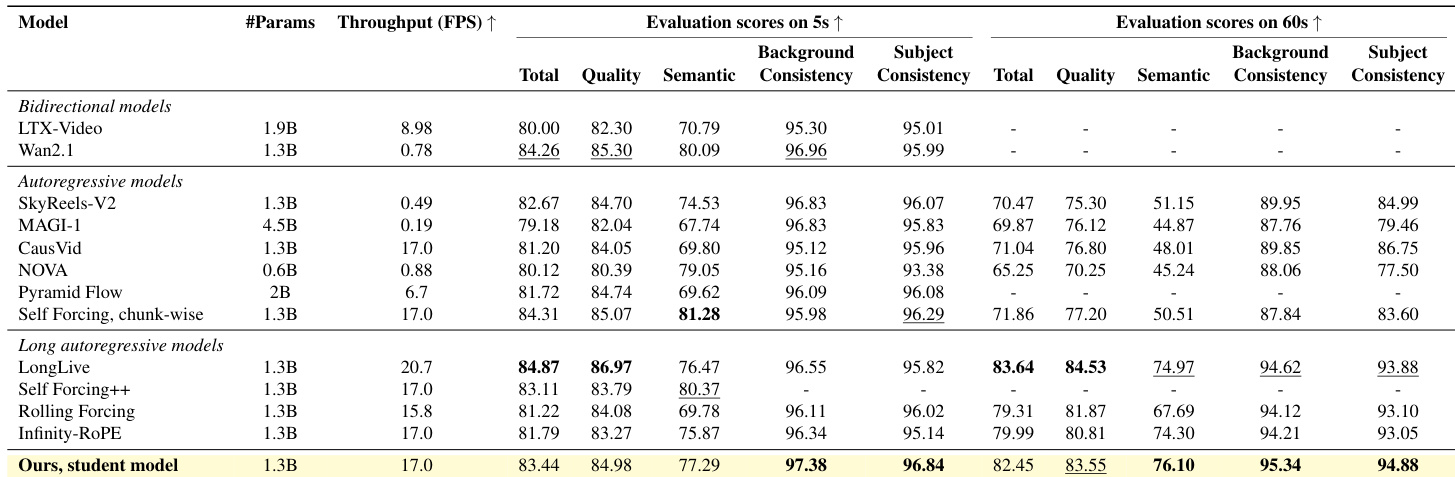
- The method achieves competitive performance on short video generation (5s) while significantly outperforming baselines in 60-second generation, particularly in preserving subject and background consistency over extended durations.
- Ablation studies confirm that similarity-based slow memory sampling, Context DMD distillation, and bounded positional encoding are each critical for maintaining semantic and temporal coherence in long videos.
- Error-Recycling Fine-Tuning enhances the context teacher’s robustness to accumulated generation errors, leading to cleaner rollouts and improved distillation quality.
- Compared to LongLive and other long-video baselines, the proposed method avoids abrupt scene resets and cyclic motion artifacts, demonstrating superior qualitative stability despite comparable quantitative scores.
The authors evaluate ablation components of their video generation system, showing that their full method outperforms variants lacking key mechanisms like contextual distillation or bounded positional encoding. Results indicate that similarity-based slow memory sampling and bounded positional encoding significantly improve background and subject consistency over long sequences. The full model achieves the highest overall score, confirming the combined effectiveness of its architectural choices in maintaining temporal coherence.

The authors use a robust context teacher and student framework to generate long videos, achieving high consistency across 60-second sequences as measured by DINOv2, CLIP-F, and CLIP-T scores. Results show their method outperforms baselines like FramePack, LongLive, and Infinity-RoPE in maintaining subject and background stability over time, particularly beyond 20 seconds. Ablation studies confirm that key components—including similarity-based memory sampling, context distillation, and bounded positional encoding—are critical to sustaining long-term coherence.

The authors use a two-stage training approach with a robust context teacher to enable long video generation, achieving high consistency in both short and extended sequences. Results show their student model outperforms most baselines in background and subject consistency for 60-second videos, particularly excelling in maintaining stable semantics and structure over time. Ablation studies confirm that key components like similarity-based memory sampling and bounded positional encoding are critical for sustaining long-term coherence.