Command Palette
Search for a command to run...
GARDO : Renforcer les modèles de diffusion sans piratage de récompense
GARDO : Renforcer les modèles de diffusion sans piratage de récompense
Haoran He Yuxiao Ye Jie Liu Jiajun Liang Zhiyong Wang Ziyang Yuan Xintao Wang Hangyu Mao Pengfei Wan Ling Pan
Résumé
Le fine-tuning des modèles de diffusion par apprentissage par renforcement en ligne (RL) a montré un grand potentiel pour améliorer l’alignement texte-image. Toutefois, puisqu’il reste difficile de définir précisément une fonction objectif véritable pour les tâches visuelles, les modèles sont souvent optimisés à l’aide d’une récompense proxy qui ne capture qu’imparfaitement le véritable objectif. Ce décalage conduit fréquemment à un phénomène de « hacking de récompense », où le score proxy augmente tandis que la qualité réelle des images se détériore et que la diversité de génération s’effondre. Bien que les solutions courantes ajoutent une régularisation par rapport à la politique de référence afin de prévenir ce phénomène, elles compromettent l’efficacité échantillonnée et entravent l’exploration de nouvelles régions à haut rendement, la politique de référence étant généralement sous-optimale. Pour répondre aux exigences concurrentes d’efficacité échantillonnée, d’exploration efficace et de réduction du hacking de récompense, nous proposons GARDO (Gated and Adaptive Regularization with Diversity-aware Optimization), un cadre polyvalent compatible avec divers algorithmes de RL. Notre idée centrale est que la régularisation n’a pas besoin d’être appliquée de manière universelle ; il est en revanche très efficace de pénaliser sélectivement un sous-ensemble d’échantillons présentant une haute incertitude. Pour surmonter le défi de l’exploration, GARDO introduit un mécanisme de régularisation adaptative, dans lequel le modèle de référence est mis à jour périodiquement pour s’aligner sur les capacités de la politique en ligne, garantissant ainsi une cible de régularisation pertinente. Pour contrer le problème de la collapse des modes en RL, GARDO amplifie les récompenses attribuées aux échantillons de haute qualité qui présentent également une grande diversité, encourageant ainsi une couverture des modes sans destabiliser le processus d’optimisation. Des expériences étendues menées sur diverses récompenses proxy et différentes métriques non vues montrent de manière cohérente que GARDO atténue efficacement le hacking de récompense, améliore la diversité de génération, sans sacrifier l’efficacité échantillonnée ni l’exploration, soulignant ainsi son efficacité et sa robustesse.
One-sentence Summary
The authors from Hong Kong University of Science and Technology, Kuaishou Technology, CUHK MMLab, and the University of Edinburgh propose GARDO, a novel framework that strengthens diffusion models through reward-free training, avoiding reward hacking by leveraging self-supervised consistency regularization, enabling more reliable and robust image generation in real-world applications.
Key Contributions
-
Fine-tuning diffusion models with proxy rewards for text-to-image generation often leads to reward hacking, where models optimize unreliable reward signals at the expense of image quality and diversity, due to the inherent limitations of model-based and rule-based reward functions in capturing true human preferences.
-
GARDO introduces a gated regularization mechanism that selectively applies KL penalties only to high-uncertainty samples—identified via ensemble reward disagreement—while allowing the rest to explore freely, and an adaptive reference model that evolves with the policy to maintain effective exploration and avoid stagnation.
-
Experiments across multiple proxy rewards and unseen evaluation metrics show GARDO consistently mitigates reward hacking, improves generation diversity, and maintains high sample efficiency, demonstrating robust performance without compromising on exploration or stability.
Introduction
Fine-tuning diffusion models for text-to-image generation using reinforcement learning (RL) is critical for aligning outputs with human preferences, yet it faces a fundamental challenge: proxy reward models—whether learned from finite human feedback or rule-based—are imperfect approximations of true human judgment. This misalignment often leads to reward hacking, where models optimize for high proxy scores at the cost of degraded image quality and reduced diversity. Prior solutions rely on KL regularization against a static reference policy to prevent over-optimization, but this approach hampers sample efficiency and stifles exploration by constraining the policy to stay close to a suboptimal baseline. The authors propose GARDO, a framework that overcomes these limitations through three key innovations. First, it introduces gated regularization that applies penalties only to a small subset of high-uncertainty samples—identified via disagreement among an ensemble of reward models—allowing the majority of samples to be optimized freely. Second, it employs adaptive regularization by periodically updating the reference model to match the evolving online policy, maintaining a relevant and effective regularization target. Third, it incorporates diversity-aware advantage shaping to amplify rewards for high-quality, diverse samples, promoting mode coverage without destabilizing training. Experiments across multiple proxy rewards and unseen metrics demonstrate that GARDO effectively mitigates reward hacking while preserving sample efficiency, exploration, and diversity.
Method
The authors leverage a reinforcement learning (RL) framework to optimize diffusion-based generative models, treating the denoising process as a Markov Decision Process (MDP). The overall framework begins with a policy model πθ, which is conditioned on a textual prompt and generates images through a multi-step denoising process. At each step t, the state st is defined as (c,t,xt), where c is the prompt, t is the current time step, and xt is the noisy image. The policy πθ predicts the action at, which corresponds to the denoised image xt−1, effectively modeling the transition from xt to xt−1. The reward function R(st,at) is non-zero only at the final step t=0, where it evaluates the quality of the generated image x0 based on a proxy reward function r(x0,c). The transition dynamics are deterministic, and the initial state sT is sampled from a predefined distribution ρ0. The objective is to learn an optimal policy π∗ that maximizes the expected cumulative reward over the trajectory.

The policy optimization is performed using a variant of the Generalized Reward Policy Optimization (GRPO) algorithm. During each training iteration, a batch of prompts is sampled, and for each prompt, G images are generated by rolling out the policy from a random noise input. The reward for each generated image x0i is computed, and the advantage Ati is estimated within the group of G samples. The policy is updated using a surrogate objective that combines a clipped importance sampling ratio with a KL divergence regularization term. This objective is designed to ensure stable policy updates while preventing large deviations from the behavior policy used for data collection.

To address the issue of reward hacking and mode collapse, the authors introduce a gated KL regularization mechanism. This mechanism selectively applies the KL penalty only to samples that exhibit high uncertainty in their proxy reward. The uncertainty is quantified by comparing the win rate of a sample's proxy reward R~ against the average win rate of the same sample across an ensemble of auxiliary reward models {R^n}n=1K. This approach ensures that regularization is applied only to samples where the proxy reward is unreliable, thereby preventing unnecessary constraints on the policy. Furthermore, an adaptive KL regularization scheme is employed, where the reference policy πref is periodically reset to the current policy πθ to maintain its relevance and prevent the KL penalty from dominating the loss and stalling exploration.
To promote sample diversity, the authors propose a diversity-aware advantage shaping strategy. This strategy reshapes the advantage function by multiplying it with a diversity score di for each generated sample. The diversity score is computed as the cosine distance to the nearest neighbor in the semantic feature space, where features are extracted using the DINOv3 model. This reshaping is applied only to samples with positive advantages, ensuring that the model is rewarded for generating high-quality and novel images. The overall training process is summarized in Algorithm 1, which integrates the policy model, reward computation, uncertainty estimation, advantage computation, diversity estimation, and the adaptive KL regularization mechanism.
Experiment
- GARDO's multiplicative advantage reshaping within positive samples improves diversity and enables discovery of low-probability modes, such as a central cluster with 0.1× reference model density, demonstrating robust exploration.
- Removing standard deviation in advantage normalization mitigates reward hacking by preventing amplification of minor reward differences, improving stability and generalization without sacrificing sample efficiency.
- On GenEval and OCR benchmarks, GARDO achieves proxy rewards comparable to KL-free baselines while significantly outperforming them on unseen metrics (Aesthetic, PickScore, HPSv3) and diversity, with diversity increasing from 19.98 to 24.95.
- GARDO’s gated and adaptive KL regularization enhances sample efficiency, matching KL-free baselines’ convergence speed while effectively suppressing reward hacking, with only ~10% of samples penalized.
- On challenging counting tasks (10–11 objects), GARDO significantly improves accuracy over base models and vanilla GRPO, demonstrating emergence of novel behaviors beyond the pre-trained distribution.
- GARDO generalizes across different base models (Flux.1-dev, SD3.5-Medium) and RL algorithms (DiffusionNFT), consistently achieving superior trade-off between sample efficiency and o.o.d. generalization, outperforming multi-reward training methods in both proxy and unseen rewards.
The authors use a counting task to evaluate the ability of different methods to generate images with novel object counts beyond the training distribution. Results show that GARDO significantly improves counting accuracy for 10 and 11 objects compared to baseline GRPO methods, which fail to generalize to these unseen counts.
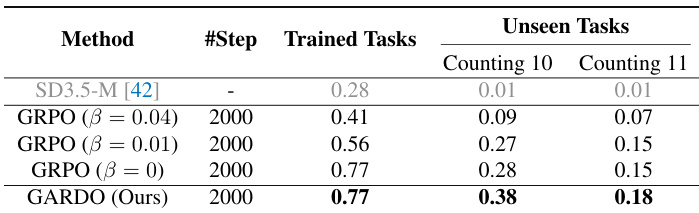
The authors use a table to compare the performance of their proposed method, GARDO, against various baselines on both proxy and unseen tasks. Results show that GARDO achieves the highest scores on both proxy rewards and unseen metrics, particularly excelling in diversity and generalization, while maintaining high sample efficiency. The method outperforms baselines that either suffer from reward hacking or are overly conservative due to strong regularization.
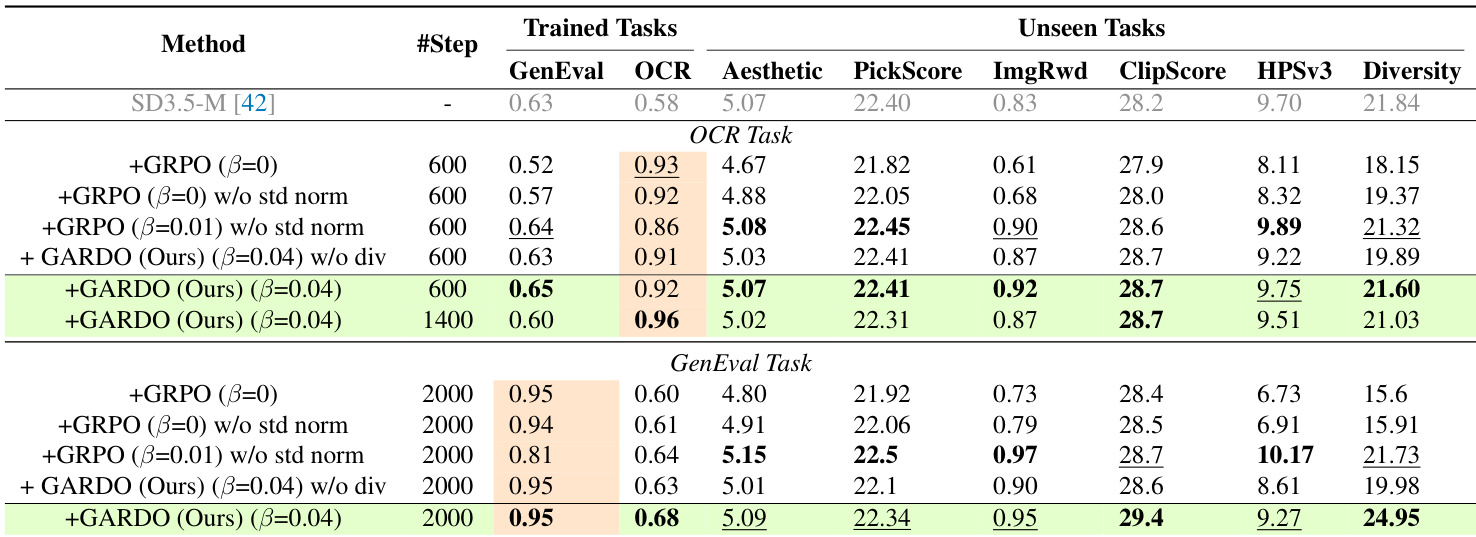
The authors use a table to compare the performance of their proposed method, GARDO, against several baselines across proxy and unseen tasks. Results show that GARDO achieves the highest scores on both proxy rewards and unseen metrics, including GenEval, OCR, Aesthetic, PickScore, and diversity, while maintaining high sample efficiency. This demonstrates that GARDO effectively mitigates reward hacking and improves generalization without sacrificing performance on the primary task.
