Command Palette
Search for a command to run...
DreamOmni3 : Édition et génération basées sur des croquis
DreamOmni3 : Édition et génération basées sur des croquis
Résumé
Récemment, les modèles unifiés de génération et d'édition ont remporté un succès remarquable grâce à leurs performances impressionnantes. Ces modèles s'appuient principalement sur des instructions textuelles pour l'édition et la génération basées sur des commandes, mais le langage peine souvent à capturer avec précision les emplacements souhaités par l'utilisateur ainsi que les détails visuels fins. A cet effet, nous proposons deux nouvelles tâches : l'édition et la génération basées sur des griffonnages, permettant une création plus flexible dans une interface graphique utilisateur (GUI) en combinant les instructions textuelles, les images et les croquis manuscrits. Nous introduisons DreamOmni3, qui aborde deux défis majeurs : la création de données et la conception du cadre d'architecture. Notre pipeline de synthèse de données comporte deux volets : l'édition et la génération basées sur des griffonnages. Pour l'édition basée sur des griffonnages, nous définissons quatre tâches : édition basée sur le griffonnage et l'instruction, édition multimodale basée sur le griffonnage et l'instruction, fusion d'images, et édition par dessin libre (doodle). À partir du jeu de données DreamOmni2, nous extrayons les régions éditables et superposons des boîtes, des cercles, des dessins libres ou des images découpées tracés à la main afin de construire les données d'entraînement. Pour la génération basée sur des griffonnages, nous définissons trois tâches : génération basée sur le griffonnage et l'instruction, génération multimodale basée sur le griffonnage et l'instruction, et génération par dessin libre (doodle), suivant des pipelines de création de données similaires. Concernant l'architecture, au lieu d'utiliser des masques binaires, qui rencontrent des difficultés dans les éditions complexes impliquant plusieurs griffonnages, images et instructions, nous proposons un schéma d'entrée conjoint qui fournit à la fois l'image source originale et l'image griffonnée au modèle, en utilisant des couleurs différentes pour distinguer les régions et simplifier le traitement. En appliquant les mêmes encodages d'indice et de position aux deux images, le modèle peut localiser précisément les régions griffonnées tout en maintenant une précision élevée dans l'édition. Enfin, nous établissons des benchmarks complets pour ces tâches afin de stimuler des recherches ultérieures. Les résultats expérimentaux montrent que DreamOmni3 atteint des performances exceptionnelles, et que les modèles ainsi que le code seront publiés publiquement.
One-sentence Summary
The authors from CUHK, ByteDance Inc., and HKUST propose DreamOmni3, a unified model for scribble-based image editing and generation that jointly processes original and scribbled source images with color-coded region differentiation, enabling precise localization and flexible GUI-driven creation beyond text-only instructions, outperforming prior methods in complex, multi-scribble scenarios and advancing interactive image manipulation.
Key Contributions
- We introduce two new tasks—scribble-based editing and generation—that extend unified generation and editing models by incorporating freehand sketches alongside text and image inputs, enabling more intuitive, flexible, and creative user interactions on graphical interfaces.
- We propose a novel joint input framework for DreamOmni3 that feeds both the original and scribbled source images into the model using color-coded scribbles and shared position encodings, allowing precise localization of edit regions without relying on complex binary masks.
- We build the DreamOmni3 benchmark with real-world image data and establish a comprehensive data synthesis pipeline for multiple scribble-based tasks, demonstrating superior performance in editing accuracy and real-world applicability through extensive experiments.
Introduction
The authors leverage recent advances in unified image generation and editing models, which integrate text and image inputs to enable flexible content creation. However, these models often struggle with precise, interactive edits—especially when users need to modify specific regions that are hard to describe with language, involve ambiguous or identical objects, or require creative additions through drawing. To address this, the authors introduce DreamOmni3, a framework that extends unified models with scribble-based editing and generation, enabling users to guide edits and generation via hand-drawn annotations. This approach overcomes limitations of mask-based methods, which rely on precise, often tedious manual segmentation and lack robustness to imprecise inputs. DreamOmni3 introduces a novel data pipeline to generate high-quality, instruction-guided scribble datasets for both editing and generation tasks, and proposes a joint input architecture that processes both source images and colored scribbles while preserving spatial alignment through shared position encodings. The model supports multimodal inputs—including text, images, and scribbles—within a unified framework, ensuring compatibility with existing architectures and enabling complex, context-aware edits. The authors further establish the DreamOmni3 benchmark using real-world data, demonstrating the model’s strong performance in practical, interactive scenarios.
Dataset
- The dataset, named DreamOmni3, is built upon DreamOmni2’s multimodal instruction editing and generation data, extended to include scribbles as instructions for both editing and generation tasks.
- It comprises two main components: a scribble-based editing dataset (70K training samples) and a scribble-based generation dataset (47K training samples), each structured into distinct task types.
- For editing:
- Scribble and multimodal instruction-based editing includes 32K samples, where Referseg locates objects in reference and target images, and manually designed scribble templates (squares and circles) are pasted onto source and reference images.
- Scribble and instruction-based editing has 14K samples, derived by removing the reference image from the above but retaining the scribble and adding object descriptions in the instruction.
- Image fusion involves 16K samples, created by removing the target object via instruction-based editing, cropping it from the reference image using Referseg, resizing, and pasting it into the source image.
- Doodle editing contains 8K samples, where Referseg identifies the object and a dedicated model converts it into an abstract sketch, avoiding Canny edge detection due to imperfect user input.
- For generation:
- Scribble-based multimodal instruction generation has 29K samples, with scribbles placed on a blank white canvas to guide object placement and attribute generation.
- Scribble-based instruction generation includes 10K samples, similar to the above but without a reference image and with object descriptions in the instruction.
- Doodle generation has 8K samples, where abstract sketches are placed on a white canvas to guide the model in generating corresponding objects and background.
- All data is processed using a joint input scheme that encodes both source and scribbled images with the same method, ensuring pixel alignment and compatibility with prior DreamOmni2 data.
- The training split uses all available samples for training, with no explicit validation or test splits mentioned—evaluation is conducted via the newly introduced DreamOmni3 benchmark.
- The benchmark uses real-world images and covers all seven task types, with evaluation based on four criteria: instruction accuracy, visual consistency (appearance, objects, attributes), absence of severe artifacts, and alignment with doodle regions.
- Evaluation leverages VLMs (e.g., GPT-Image-1) for automated assessment, with results shown to closely match human evaluations, ensuring reliability and real-world relevance.
Method
The authors leverage a unified framework for scribble-based image editing and generation, building upon the DreamOmni2 architecture while introducing a novel joint input scheme to handle freehand sketch instructions. The overall framework, as shown in the figure below, integrates both text and visual inputs through a multimodal model (MM-DIT) that processes a combination of source images, scribbled images, and textual instructions. The core innovation lies in the joint input scheme, which feeds both the original source image and a modified version with scribbles into the model simultaneously. This approach avoids the limitations of binary masks, which become cumbersome when multiple scribbles are present, as each requires a separate mask and complex language-based correspondence. Instead, the joint input uses color-coded scribbles to distinguish regions, enabling simple language instructions to establish correspondences via image indices and scribble colors.
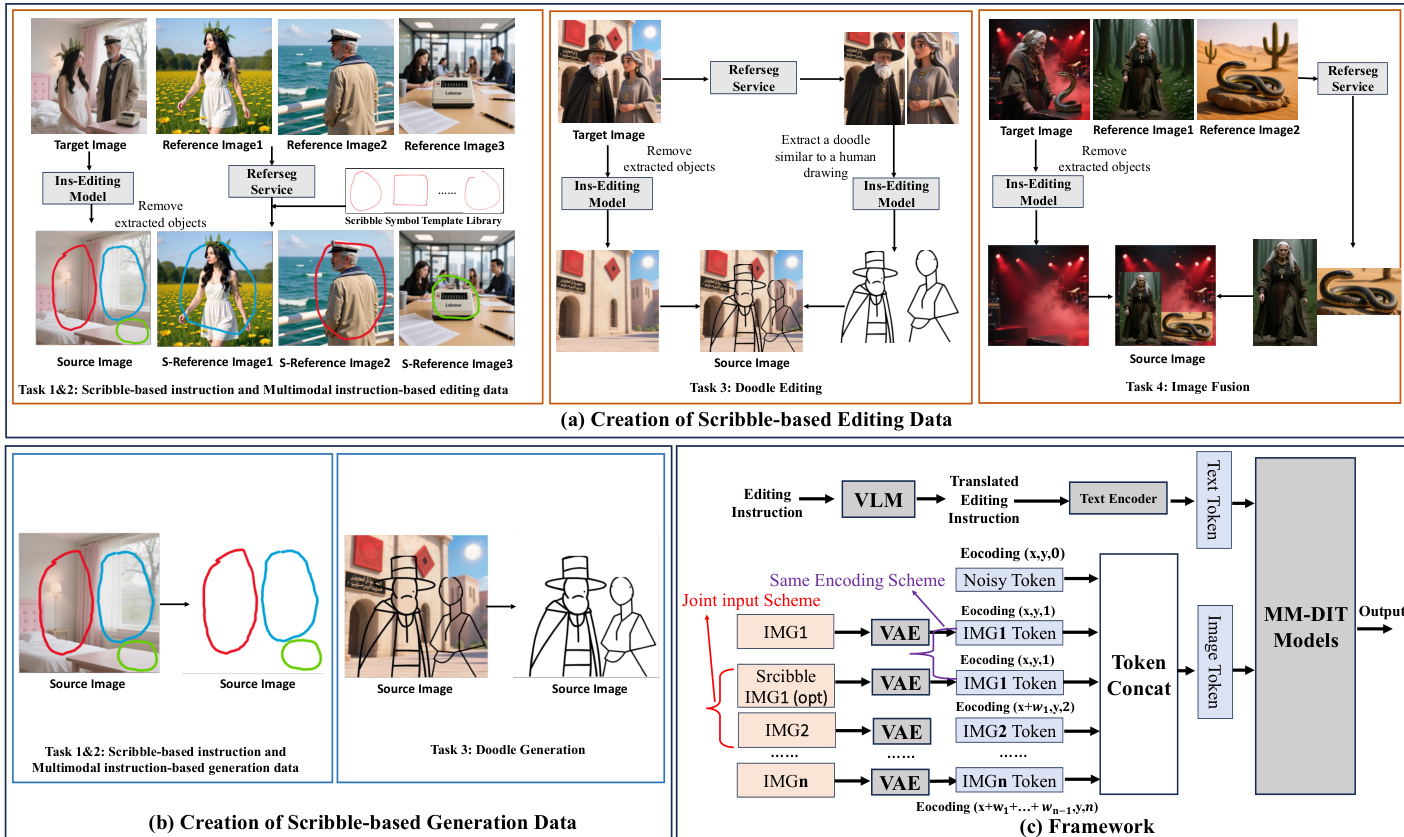
The framework processes inputs through a series of modules. Textual editing instructions are first translated into a structured format by a vision-language model (VLM), which then passes the instruction to a text encoder to generate text tokens. Simultaneously, the source image and the scribbled image (if applicable) are encoded using a Variational Autoencoder (VAE) to produce image tokens. To ensure accurate alignment between the original and scribbled images, both are subjected to the same index and position encoding scheme, which preserves spatial relationships and enables the model to maintain pixel-level consistency in non-edited regions. These encoded tokens are concatenated and fed into the MM-DIT model, which generates the final output. The joint input scheme is applied selectively: during editing tasks where the source image contains scribbles, both the original and scribbled images are input; during generation tasks or when reference images contain scribbles, the joint input is omitted to avoid unnecessary computational overhead. This selective use of the joint input scheme ensures efficiency while maintaining the model's ability to handle complex, multi-scribble editing scenarios.
Experiment
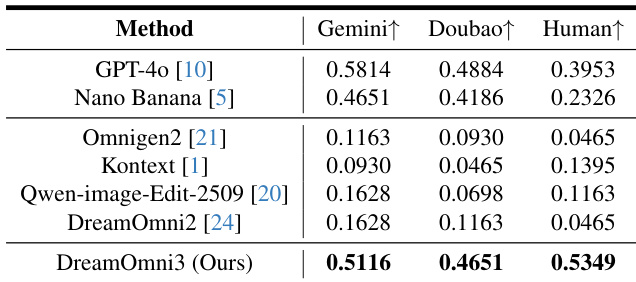
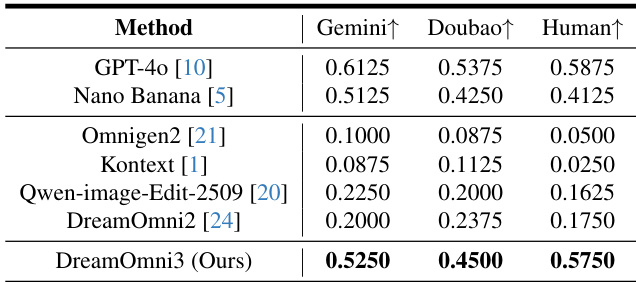
- Evaluated scribble-based editing on DreamOmni3 benchmark using Gemini 2.5, Doubao 1.6, and human assessments (5 reviewers per case); DreamOmni3 achieved the highest pass rates in human evaluation and outperformed open-source models, with results comparable to GPT-4o and Nano Banana, though GPT-4o showed yellowing and pixel mismatches, and Nano Banana exhibited copy-paste effects and proportion errors.
- In scribble-based generation, DreamOmni3 surpassed open-source models (DreamOmni2, Qwen-image-edit-2509) and matched the performance of GPT-4o and Nano Banana, with both human and VLM evaluations confirming its superiority; commercial models still generated unwanted scribbles despite instructions.
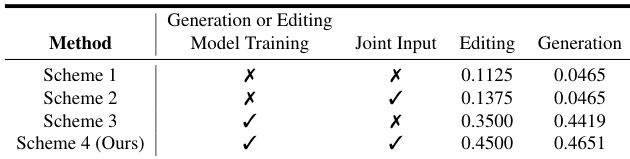
- Joint input experiments demonstrated that training with the custom dataset and using both source and scribbled images as input significantly improved editing performance, especially for pixel-level consistency, while generation benefits were less pronounced due to lower need for exact pixel alignment.
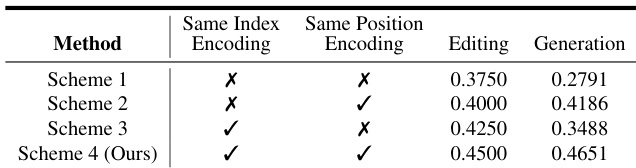
- Index and position encoding experiments showed that using identical encoding for both source and scribbled images yielded the best results, enabling better pixel-level alignment and preserving editing accuracy, while maintaining compatibility with pre-trained capabilities.
The authors compare different joint input schemes for scribble-based editing and generation, showing that training with joint input (source and scribbled images) significantly improves performance. Scheme 4, which uses joint input and training on the custom dataset, achieves the highest success rates in both editing (0.4500) and generation (0.4651), outperforming all other schemes.
Results show that DreamOmni3 achieves the highest pass rates across all evaluation metrics, outperforming both open-source models and commercial models like GPT-4o and Nano Banana in scribble-based editing. The authors use Gemini, Doubao, and human evaluators to assess the success of edits, with DreamOmni3 demonstrating superior accuracy and consistency compared to competing methods.
Results show that DreamOmni3 achieves the highest pass rates across all evaluation metrics, outperforming both open-source models and commercial models like GPT-4o and Nano Banana in scribble-based editing. The authors use Gemini, Doubao, and human evaluators to assess the success of edits, with DreamOmni3 demonstrating superior accuracy and consistency compared to competing methods.
Results show that using the same index and position encoding for both source and scribbled images significantly improves performance in both editing and generation tasks. The authors use Scheme 4, which combines joint input with identical encoding, to achieve the highest scores, demonstrating that consistent encoding enhances pixel-level alignment and preserves image details.