Command Palette
Search for a command to run...
Rapport technique Step-DeepResearch
Rapport technique Step-DeepResearch
Résumé
Alors que les grands modèles linguistiques (LLM) évoluent vers des agents autonomes, la recherche approfondie (Deep Research) est devenue un indicateur clé. Toutefois, les benchmarks académiques existants, tels que BrowseComp, peinent souvent à répondre aux exigences réelles de la recherche ouverte, qui requiert des compétences solides en reconnaissance d’intention, en prise de décision à long terme et en vérification croisée entre sources. Pour remédier à ce manque, nous introduisons Step-DeepResearch, un agent entièrement intégré et à faible coût. Nous proposons une stratégie de synthèse de données fondée sur des capacités atomiques afin de renforcer la planification et la rédaction de rapports, combinée à une trajectoire d’entraînement progressive allant de l’entraînement intermédiaire agencé à la SFT (Supervised Fine-Tuning) et à la RL (Reinforcement Learning). Renforcée par un évaluateur de type liste de contrôle (Checklist-style Judger), cette approche améliore significativement la robustesse. En outre, afin de combler le fossé d’évaluation dans le domaine chinois, nous établissons ADR-Bench, un benchmark dédié à des scénarios de recherche approfondie réalistes. Les résultats expérimentaux montrent que Step-DeepResearch (32B) obtient un score de 61,4 % sur les critères de notation Scale AI Research. Sur ADR-Bench, il surpassait significativement les modèles comparables et rivalise avec les meilleurs modèles fermés de pointe tels qu’OpenAI et Gemini DeepResearch. Ces résultats démontrent que, grâce à une entraînement raffiné, des modèles de taille moyenne peuvent atteindre des capacités expertes avec une efficacité coût-industrie exceptionnelle.
One-sentence Summary
StepFun researchers propose Step-DeepResearch, a cost-effective 32B-parameter agent model for open-ended deep research tasks, introducing a novel Atomic Capabilities-based data synthesis strategy and progressive training with a checklist-style reward system. It achieves expert-level performance on RESEARCHRUBRICS (61.42) and a new Chinese-language benchmark, rivaling proprietary services like OpenAI DeepResearch while significantly reducing deployment costs.
Key Contributions
- Existing Deep Research evaluations like BrowseComp focus on academic multi-hop search with ground truth, failing to address real-world open-ended research demands requiring latent intent recognition, long-horizon decision-making, and cross-source verification. This gap limits agent usability despite industrial progress in systems like OpenAI DeepResearch.
- The authors introduce Step-DeepResearch, a 32B-parameter agent trained via a novel Data Synthesis Strategy Based on Atomic Capabilities (targeting planning, information seeking, reflection, and report writing) and a progressive pipeline from agentic mid-training to supervised fine-tuning and reinforcement learning with a Checklist-style Judger reward.
- Evaluated on the new Chinese ADR-Bench benchmark covering commercial, policy, and software engineering scenarios, Step-DeepResearch achieves a 61.42 score on RESEARCHRUBRICS and surpasses open-source models while rivaling OpenAI DeepResearch and Gemini DeepResearch in expert Elo ratings, demonstrating cost-effective expert-level performance.
Introduction
The authors recognize that real-world Deep Research—addressing open-ended, complex information-seeking tasks—demands capabilities beyond academic multi-hop question answering, including latent intent recognition, long-horizon planning, cross-source verification, and structured synthesis. Prior agent systems either over-optimized for retrieval accuracy in constrained benchmarks like BrowseComp, producing fragmented "web crawlers" rather than coherent researchers, or relied on complex multi-agent orchestration that increased deployment costs and reduced robustness in practical scenarios. To bridge this gap, the authors introduce Step-DeepResearch, a 32B-parameter model trained via a novel atomic capability data synthesis strategy that decomposes research into trainable skills (planning, reflection, verification) and a progressive training pipeline from mid-training to reinforcement learning. This end-to-end approach internalizes expert-like cognitive loops within a single agent, enabling cost-effective, high-quality research performance that rivals larger proprietary systems while addressing real-world usability gaps.
Dataset
The authors construct a synthetic training dataset through three primary methods to address gaps in existing research benchmarks:
-
Dataset composition and sources
The core training data is synthetically generated from high-quality sources including open-access technical reports, academic surveys, financial research documents, Wikidata5m, and CN-DBpedia knowledge graphs. This approach ensures coverage of real-world research complexity where public benchmarks lack depth. -
Key subset details
- Planning & Task Decomposition data: Reverse-engineered from report titles/abstracts using LLMs to create complex queries and feasible plans. Filtered via trajectory consistency checks to retain only paths aligning with preset plans.
- Reasoning data: Built via graph-based synthesis (10-40 node subgraphs from Wikidata5m/CN-DBpedia) and multi-document walks (using Wiki-doc hyperlinks). Queries undergo difficulty filtering using QwQ-32b to exclude solvable "simple problems."
- Reflection & Verification data: Generated through closed-loop pipelines for self-correction and fact-checking, incorporating structured noise (e.g., tool errors with recovery steps).
- Report data: Mid-training uses 〈Query, Report〉 pairs from screened human reports (e.g., financial analyses), with queries reverse-engineered from document content.
-
Usage in model training
- Mid-training: Focuses on atomic capabilities (planning, retrieval) using domain-style 〈Query, Report〉 pairs and reasoning subsets.
- SFT stage: Combines two trajectory types at optimized ratios:
- Deep Search: Ground-truth answer tasks prioritizing "correct and shortest" trajectories for efficiency.
- Deep Research: Open-ended tasks covering full pipelines (planning to citation-rich reporting), constituting the majority for end-to-end logic reinforcement.
Mixture ratios emphasize Deep Research data to align with real-scenario demands.
-
Processing and quality controls
- Trajectory efficiency filtering retains only minimal-step successful paths.
- Strict N-gram deduplication removes repetitive reasoning loops.
- Citation formatting (\cite{}) is enforced in reports for factual grounding.
- Controlled noise injection (e.g., 5-10% tool errors) builds robustness to real-world instability.
Evaluation uses ADR-Bench with 90 real-user queries across nine domains (20 professional-law/finance, 70 general), rigorously validated by domain experts.
Method
The authors leverage a ReAct-inspired single-agent architecture to structure the Step-DeepResearch system, enabling dynamic, iterative reasoning through alternating phases of thought generation and tool interaction. As shown in the figure below, the agent receives a user query and initiates a multi-turn loop in which it alternates between internal reasoning (enclosed in <tool_call> tags) and external tool invocation (via <toolcall>), with each tool response fed back into the next reasoning step. This cycle continues until the agent produces a final report, marked by an <answer> tag, which is then delivered as a structured document.
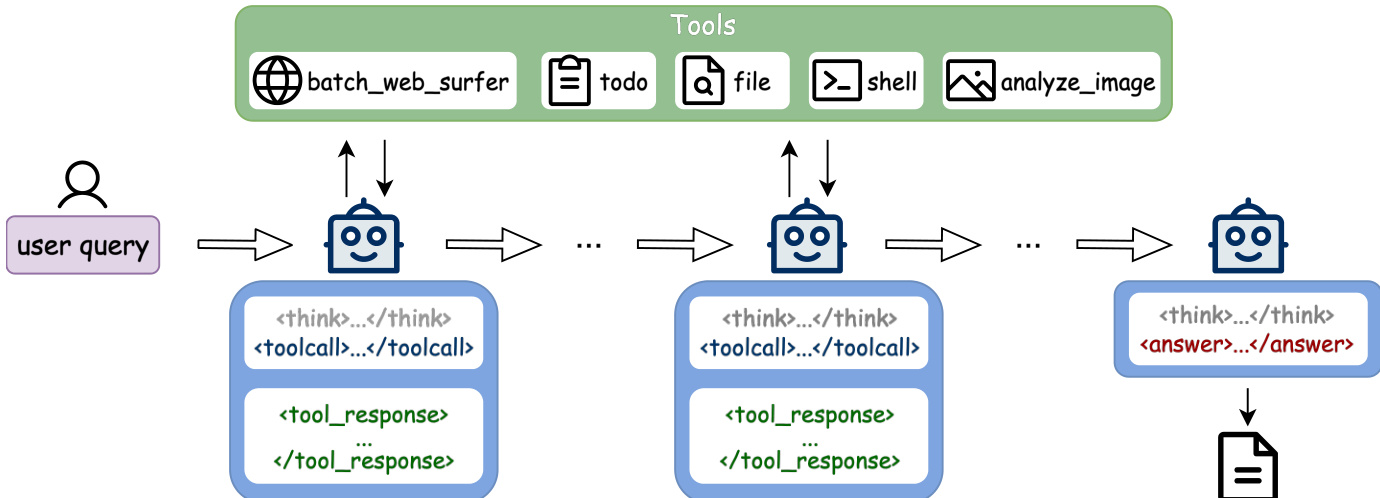
The agent’s core operational loop is supported by a unified tool system designed for capability alignment, information adaptation, and architectural simplification. Key tools include batch_web_surfer for high-precision information retrieval, todo for stateful task tracking, file for token-efficient document editing and local storage, shell for sandboxed terminal execution, and analyze_image for multimodal perception. These tools are not merely wrappers but are engineered to preserve human-like interaction logic while optimizing for token efficiency and long-context robustness.
For information acquisition, the system employs a curated authority indexing strategy, isolating over 600 authoritative domains to ensure factual grounding. Knowledge-dense retrieval operates at paragraph-level granularity to maximize information density per token, while authority-aware ranking heuristics prioritize high-trust sources when semantic relevance is comparable. During execution, the agent leverages a patch-based editing protocol to minimize token overhead during report refinement and a summary-aware local storage mechanism to offload context pressure to disk, enabling near-infinite context support.
To support long-horizon reasoning, the system integrates stateful todo management that decouples research progress from model weights, ensuring goal alignment across extended trajectories. Interactive execution is enhanced through tmux-integrated sandboxing, allowing stable operation of stateful command-line tools, and a perception-optimized browser that suppresses redundant visual feedback via perceptual hash comparison, reducing multimodal token redundancy.
The agent’s behavior is governed by a policy πθ that maps states—comprising user intent, historical tokens, and tool observations—to actions, which may include natural language generation or structured tool calls. Training proceeds through a three-stage pipeline: mid-training to instill atomic capabilities, supervised fine-tuning to enforce instruction following and formatting, and reinforcement learning to optimize for real-world task performance. In the RL stage, the agent interacts within a multi-tool environment under explicit budget constraints, and its performance is evaluated via a rubric-based reward system. The reward signal is derived from a trained Rubrics Judge model that maps fine-grained rubric judgments to binary signals—either 1 or 0—based on whether each rubric is fully satisfied, eliminating ambiguity from intermediate categories. Policy updates are performed using the clipped PPO objective, with advantage estimation via GAE (γ=1,λ=1) to simplify credit assignment in long-horizon, sparse-reward settings.
Experiment
- Stage 1 mid-training (32K context) validated gains in structured reasoning, achieving +10.88% on FRAMES benchmark after 150B tokens, with steady improvements on SimpleQA (+1.26%) and TriviaQA (+2.30%).
- Stage 2 mid-training (128K context) validated enhanced tool-augmented reasoning for real-world tasks, enabling retrieval and multi-tool collaboration under ultra-long contexts.
- Step-DeepResearch achieved 61.42 on RESEARCHRUBRICS benchmark, surpassing open-source models by +5.25 (e.g., Kimi-k2-thinking) and nearing Gemini DeepResearch (63.69), while costing under 0.50 RMB per report—less than one-tenth of Gemini (6.65 RMB).
- On ADR-Bench human evaluation, Step-DeepResearch won 30 out of 70 comparisons against its non-midtrained version and achieved 67.1% non-inferiority rate against top commercial systems, leading in AI/ML (64.8), Historical Analysis (65.8), and Technical Documentation (64.6) domains.