OpenAI Expands Robotics Efforts with Data-Driven Approach to Building Humanoid Robots
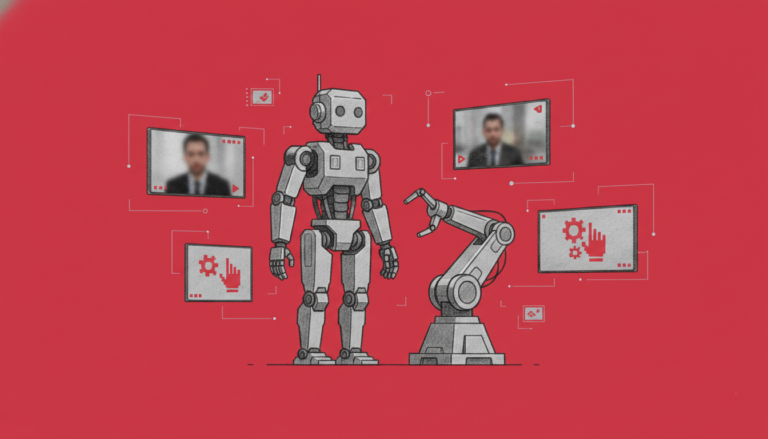
OpenAI is quietly advancing its robotics ambitions with a newly expanded lab in San Francisco, signaling a renewed commitment to building humanoid robots. Though the company has historically focused on AI models like ChatGPT, insiders say OpenAI has been building a robotics team over the past year, now employing around 100 data collectors and operating out of the same building as its finance department. The lab’s primary focus is on training robotic arms to perform everyday household tasks—such as placing a rubber duck in a cup, putting bread in a toaster, or folding laundry—using teleoperation. Workers use 3-D printed controllers called GELLOs to remotely control two Franka robotic arms, which are manufactured by the German company Franka. The setup is designed to capture high-quality human movement data that can be used to train AI models to replicate these actions. Since launching in February 2025, the lab has more than quadrupled in size. OpenAI has also announced plans to open a second facility in Richmond, California, with a December job posting indicating the location for a robotics operator role. Despite the presence of a humanoid robot described as “iRobot-like,” it remains largely inactive, with most of the team’s efforts centered on data collection rather than full robot deployment. Unlike competitors such as Tesla and Figure, which use motion capture suits and VR headsets to control full humanoid robots, OpenAI’s approach relies on low-cost, scalable data collection through teleoperated arms. This method mirrors a 2023 study from UC Berkeley on efficient robotics data gathering, and one of its researchers joined OpenAI in August 2024 to work on “Building the Robot Brain.” The strategy reflects a broader industry challenge: while AI algorithms are capable of learning from large datasets, collecting that data at scale remains difficult. OpenAI’s model, which uses performance-based metrics and operates in three shifts around the clock, is similar to how the company scaled data labeling for its language models. Workers are evaluated on the number of “good hours” of functional data they produce. The company has previously invested in robotics startups like Figure, 1X, and Physical Intelligence, though its partnership with Figure ended in early 2025. OpenAI’s current effort appears to be a pivot from earlier reinforcement learning experiments—where robots learned through trial and error—to a data-driven approach focused on imitation learning. Experts say the method is cost-effective and technically sound, but still early. “It’s very early in the process,” said Jonathan Aitken, a robotics expert at the University of Sheffield. “But the interface is configurable and scalable.” OpenAI has also begun exploring partnerships with U.S.-based manufacturers for consumer devices, robotics, and cloud infrastructure, though it has not disclosed spending plans or timelines. The company has not commented on the robotics lab’s activities. While OpenAI’s current focus is on building a foundation of training data, the long-term goal remains unclear. Whether this arm-based, data-heavy strategy will lead to a functional humanoid robot—or simply a stepping stone to broader AI-powered devices—remains to be seen.