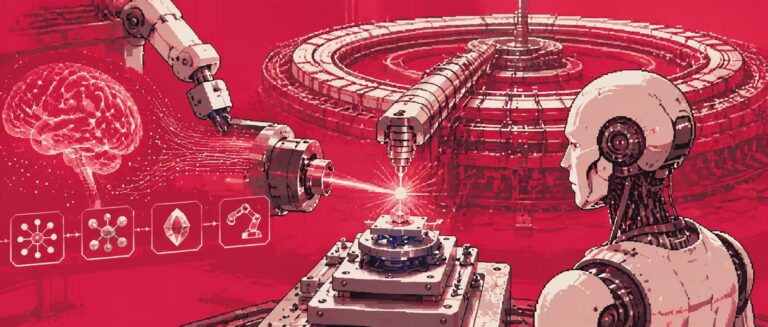
AI Agents Join Mars Life Hunt, Automating Astrobiology Research
A team of AI scientists is joining the quest to find extraterrestrial life, with a novel system called AstroAgents set to analyze Martian rock samples for signs of organic molecules. This project, presented at the International Conference on Learning Representations in Singapore on April 27, uses a sophisticated approach to automate the scientific process, from data analysis to hypothesis generation. AstroAgents consists of eight specialized AI agents, each tasked with a unique role in the research process. These include a data analyst, a planner, and a critic, among others. The system aims to provide deeper insights into molecular formation in space, molecular origins on Earth, and the preservation of these molecules, ultimately guiding researchers in identifying which specific signs to look for in Martian samples. Denise Buckner, an astrobiologist at NASA's Goddard Space Flight Center in Greenbelt, Maryland, emphasizes the tool's ability to enhance our understanding of these complex processes. "It's helping us build a better understanding of how molecules form in space, how they form from life on Earth, and how they are preserved. Then, it helps us determine which specific signs we should be searching for," she explains. AstroAgents represents a significant advancement in agentic AI systems, which are based on large language models (LLMs). Unlike conventional AI tools, these systems actively participate in the scientific process by making decisions, conducting evaluations, and adapting their methods based on outcomes. Michael Wong, an astrobiologist at Carnegie Science’s Earth and Planets Laboratory in Washington DC, notes that applying agentic AI to astrobiology is a groundbreaking step. The behavior of each agent is specified through distinct prompts fed into an LLM. For instance, the data analyst is instructed to find significant patterns in the data, the planner decides which tasks to delegate to other agents, and the critic evaluates the generated hypotheses and suggests refinements. This division of labor among specialized agents is a key innovation, according to co-author Amirali Aghazadeh, a computer scientist at the Georgia Institute of Technology in Atlanta. He explains, "Because of the complexity of the data, it's better for the agent to assign multiple tasks to multiple 'scientists.'" The planner autonomously determines these delegated tasks, highlighting a crucial aspect of AstroAgents' functionality. To test AstroAgents, the research team used two LLMs: Claude Sonnet 3.5 and Gemini 2.0 Flash. They provided the systems with mass-spectrometry data from eight meteorites and ten soil samples from diverse locations on Earth, such as Antarctica and the Atacama Desert in Chile. Over ten rounds of refinement, AstroAgents generated a multitude of hypotheses and refined them through a collaborative process among the agents. The development of AstroAgents is part of a broader trend in AI where machines are increasingly taking on roles traditionally reserved for human researchers. Google's own AI co-scientist, released in February, has already been applied to areas like finding treatments for liver disease and studying antimicrobial resistance. The emergence of these agentic AI systems has sparked discussions about their potential to generate truly original scientific ideas and the nature of novelty in scientific research. Despite the debates, the introduction of AstroAgents to the field of astrobiology signals a promising shift toward more automated and efficient scientific exploration. As NASA plans to retrieve rock samples from Mars, the system will play a vital role in analyzing these materials for any indicators of past or present life, offering both speed and precision in the search for extraterrestrial biology.